Hellenistic Greek Sculpture
At the end of the 400's BC, Greece, and especially Athens, was devastated by a terrible war which involved nearly all the Greek city-states, the Peloponnesian War. The end of the war left the Greeks too poor for much sculpture, but when people did begin creating new sculpture again it was in a new style. There is more emotion, especially sad feelings like grief. There is more interest in women, who are sometimes shown without clothes now. Portraits of individuals also became more popular.
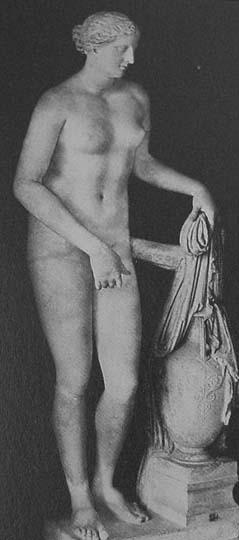
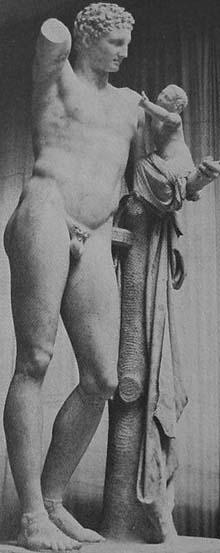
There are several famous sculptors from the Hellenistic period. One was Praxiteles (pracks-IT-uh-lees), who worked around 340 BC (the same time as Aristotle). Praxiteles carved a statue of Hermes and the infant Dionysos at the Temple Praxiteles also carved a statue of Aphrodite which was so lifelike (people say) that men actually fell in love with it and tried to kiss it. But this one does not survive, only a later Roman version.
Lysippus was another famous Hellenistic sculptor, the favorite sculptor of Alexander the Great. His most famous work is the Apoxyomenos, of a young man scraping the oil from his skin with a strigil. It was carved around 320 BC, a little after the death of Alexander. But this work, originally made out of bronze, now survives only in a Roman version in marble.
