The Bible in Historical Context: Tracing Ancient Roots Through Scripture and Archaeology

The Bible in Historical Context: Tracing Ancient Roots Through Scripture and Archaeology hero image

The Bible is not only in the form of a central text of faith for billions of people, but also as an important historical document that reflects the cultures, empires and societies of the ancient East and Mediterranean Sea. To understand its context, both the accounts of the scriptures and the evidence certified from archeology and ancient history require to examine both. Today, with the aid of online Bible study tools, scholars and lay readers alike can cross-reference scripture with historical data more effectively than ever before.

Initial beginning: Mesopotamia and Patriarchy

The initial chapters of origin place humanity in Mesopotamia, "land between rivers" (tigris and euphrates). This region is historically considered to be the home of Sumer, Akkad, Babylon and Asaria, the cradle of civilization. Genesis 11 Recalls the story of Babel's tower, which scholars often connect with ziggurats on a large scale-which include temple-tawers in Mesopotamian cities such as Ur and Babylon.

It is said that Israel's patriarch Abraham has come from "Ur of the tricks" (Genesis 11:31). Archaeological evidence confirms Ur as a rich Sumerian city by the early 2 Millenniums BCE with advanced writing systems, business networks and religious practices. It anchors the story of the Bible within a known cultural and historical scenario.

Egypt and migration

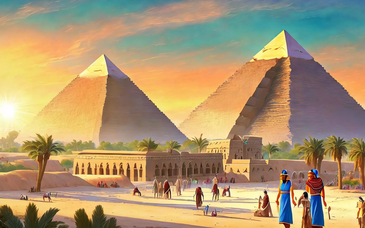
The book of Exodus has described the slavery of the Israelites in Egypt and their dramatic liberation under Moses. The history of Egypt recorded the presence of semritic people in the Neil Delta during the New Kingdom period. Haxos, a semritic group once ruled some parts of northern Egypt (C. 1650–1550 BCE), explains how non-people can settle in power and grow.

While the direct evidence of migration remains a debate, Egyptian records mentioned the labor groups of Asiatics, and archaeological discoveries in Canaan - such as sudden changes in settling patterns in the late bronze era - reflect the arrival of new ones, possibly bilious accounts.

Israel's rise and David's kingdom

The duration of judges and the emergence of the monarchy marks an infection to the centralized state from the tribal conflict. The Bible recorded Saul as the first king of Israel, followed by David, who established Jerusalem as the capital (2 Samuel 5: 6–9). Archaeological discoveries, such as Oil Dan Stell (9th century BCE), refer to "House of David", which confirm the historical existence of his dynasty.

David's son Solomon is remembered for the construction of the first temple (1 Kings 6). Although its remains were certainly not located, the description of Fonisian craftsmanship in 1 Kings 5 ​​is known about the majority of tires during that era.

Exile and return

In 586 BC, Judah's Babylonian conquests led to exile of the temple's destruction and the population of the population. The incident recorded in 2 Kings 25 and lament, showing destruction from this period, has been confirmed by Babylonian Chronicles and Archaeological layers in Jerusalem.

The Persian king Cyrus the Great later allowed the Jews to return and reconstruct the temple (Ezra 1: 1-4), a decree was also recorded on the Cyrus cylinder, which reflects their general policy of restoring the displaced people.

Greek-Roman world and new rule

By the time of the new rule, the Jews lived under gradual empires - Sharia, Helenistic and Roman. Gospels Galiles and Jesus are located in Jesus during the reign of Herodes the Great and Roman Governor Pontius Pilate. The existence of Pilat is confirmed by Pilate Stone, which is discovered in the Causaria Maritima.

Inspired Paul's letters are Roman cities such as Corinth, Ephesus, and Philippi -Vaes -Velves, where archaeological ruins, inscriptions and Roman records still testify their prominence in the first century CE.

Holy Scripture and History in Modern Studies

Bible and history is a delicate function, requiring careful interpretation of both texts and archaeological discoveries. For believers, the historical grounding of Holy Scripture deepens. For historians, the Bible is an invaluable cultural artifacts that reflect the world vision of ancient people.

Today, online Bible study equipment provides unprecedented access to comments, consent, interlinear texts and historical background resources. These instruments allow readers to compare translations, analyze the original Hebrew and Greek, and analyze the cross-reference biblical passage with ancient near Eastern and Greek-Roman history. They serve as bridges between confidence and scholarships, making the centuries of study accessible to anyone with internet access.

The Bible is not an isolated text, but is deeply inherent in the historical realities of the ancient world. From the ziggurats of Mesopotamia to the courts of Rome, its stories resonate in archeology, inscriptions and historical history. Modern technology, especially online Bible study equipment, enhances our ability to understand the Holy Scripture in its original context, combine confidence with a wide sweep of human history.

You Might Also Like:

The Amorites

The Amorites The Amorites were members of an ancient Semitic-speaking people who dominated the history of Mesopotamia, Syria, and Palestine from about 2000 to 1600 BC. In the oldest cuneiform sources (c. 2400–c. 2000 BC), the Amorites were equated with the West, though their true place of origin was...
Read More

The Bible

A History Christianity Edited By: Robert A. Guisepi The Bible Author: Ryan Cameroon Many religions have a literature that serves as a foundation for belief and practice among their followers. For Judaism and Christianity such a literature is found in the Bible--a term derived from the Greek meaning...
Read More

Mesopotamian

Mesopotamian/Sumerian Calendar In Mesopotamia the solar year was divided into two seasons, the "summer," which included the barley harvests in the second half of May or in the beginning of June, and the "winter," which roughly corresponded to today's fall-winter. Three seasons (Assyria) and four sea...
Read More

Origin of the Bible related image
Read More

Origin of the Bible

Origin The Bible is more wonderful and unique than any other book in the world. This is apparent from a variety of ways. No one man or group of men planned the Bible. It was written in different lands over a period of 1600 years. The very existence of such a book is an overwhelming proof that the B...
Read More

Egyptian and Hittite Empires, 1279 BCE

Conquest by Hyksos and Egyptian Expansion to Ramses II Eventually, like previous dynasties, the Twelfth Dynasty fell. And the Thirteenth Dynasty, at Memphis, waned across its 150 years of rule and fell with what by now was an old phenomenon: invasion by a foreign army, around the year 1650 BCE. The ...
Read More

Timelines & Charts related image
Read More

Timelines & Charts

Bible timelines are a useful tool for understanding the historical context of the Bible and the chronological order of events and stories mentioned in the text. These timelines provide a visual representation of the events and figures described in the Bible, and they can help readers to better under...
Read More

Resources related image
Read More

Resources

When studying the Bible, it is important to have access to reliable resources and references to help deepen one's understanding and knowledge of the text. There are a variety of resources available to those interested in exploring the Bible, including commentaries, study guides, and dictionaries. On...
Read More

Ancient Egypt related image
Read More

Ancient Egypt

Welcome to the ideal place to start exploring the wonders of the Ancient Egypt. Find out all about this amazing culture, and learn about the gods they worshiped, the Pharaohs that ruled and the tombs and statues they left behind. find out about Tutankhamun, Akhenaten and the other celebrities of t...
Read More

Maps of Ancient Egypt

Ancient Egypt had its origin in the course of the Nile River. It reached three periods of great pharaonic splendor: the Ancient Kingdom, the Middle Kingdom and the New Kingdom. Ancient Egypt map domain stretched from the delta of the Nile in the north, to Elephantine Island, where is the first catar...
Read More

Burial Customs

Mummy and Coffin of Meresamun Cartonnage, pigment, human remainsThird Intermediate Period, Dynasty 22, ca. 946-712 B.C.Purchased in Luxor, 1920OIM 10797 This colorful cartonnage mummy case, which still contains the mummy of an ancient Egyptian woman, is inscribed with the name Meresamun ("She lives ...
Read More

King List

The Early Dynastic Period -0 : 1 : 2 : The Old Kingdom -3 : 4 : 5 : 6 : The First Intermediate Period -7+8 : 9+10 : The Middle Kingdom -11 : 12 : The Second Intermediate Period -13 : 14 : 15 : 16 : 17 : The New Kingdom -18 : 19 : 20 : The Third Intermediate Period -High Priests (Thebes) : 21 : 22 : ...
Read More

Mummy

Interesting facts and information about the mummification process. The mummy shown here dates from the Roman Period. It has a distinctive painting inlaid into the head part, and is intricately bandaged and studded. The feet are molded in gold painted plaster, which is typical of the period. ...
Read More

Thoth, the Egyptian God of Wisdom and Writing related image
Read More

Thoth, the Egyptian God of Wisdom and Writing

The god Thoth was worshiped in the form of an Ibis, and is often shown in human form with the unusual head of that bird. Thoth was primarily thought to be the god of wisdom. He was patron of arts and science and also the patron god of scribes. He was the inventor of the words of god, or Hieroglyphs...
Read More

Anubis related image
Read More

Anubis

The Ancient Egyptians held a great reverence for the Jackal headed god Anubis, who oversaw the embalming and mummification process as well as escorting the deceased through the procedures for entering the underworld.When the person arrived for judgment, they would first declare their purity before...
Read More

The Palace of Rameses III

Symbolism in Architecture Mohammed Motlib The Window of Appearance The Temple Palace of Rameses III at Medinet Habu 1175 BC The window, situated at the centre of the eastern face of this palace, has a set of stairs behind it descending into a columned hall. Rameses III would come through this hall a...
Read More