The Women of Athens
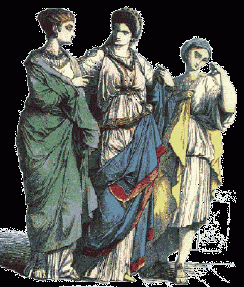
Compared to the women of Sparta, the status of an Athenian woman in Greek society was minimal. By comparison to present day standards, Athenian women were only a small step above slaves by the 5th century BC. From birth a girl was not expected to learn how to read or write, nor was she expected to earn an education. On reading and writing, Menander wrote, "Teaching a woman to read and write? What a terrible thing to do! Like feeding a vile snake on more poison." Other authors and philosophers had similar quips about women.
Most of what has been written about Athenian women comes from the 7th century BC onward, when education in Athens began to emerge. Prior to that date, it has been alluded to by some authors, that the status of women was not so glum. In particular, the rights of women in Athens and their decline may have been the direct result of political pressures brought about by Pericle's ruling on the legitimacy of marriage. Similarly there is evidence to suggest that Athenian women prior to the 7th century BC had been subject to similar rites of passage as boys. The scholar Jean-Pierre Vernant, wrote that the Arrephoroi, and many other religious celebrations of Athens, could have been reduced from perhaps an entire age grade's participation, to only a handful of girls who were chosen to participate. Even then, it was only the noble and upper class families which were considered for participation.
Athenian women can be classified into three general classes. The lowest class was the slave women, who carried out more of the menial domestic chores, and helped to raise the children of the wife. Male slaves held the task of working in the trade arts (pottery making, glass working, wood working, etc) or to educate the sons of a house. The second class was that of the Athenian citizen woman. The third class was known as the Hetaerae. The hetaerae unlike the slaves and the citizens, were much akin to the Geisha's of China. Hetaerae women were given an education in reading, writing, and music, and were allowed into the Agora and other structures which were off limits to citizen and slave women. Most sources about the Hetaerae indicate however, that their standing was at best at the level of prostitutes, and the level of power they attained was only slightly significant.
Marriage
Athenian citizen girls, since birth were raised differently than their male counterparts. Jean Vernant, likened the difference to the phrases of Xenophon, that "boys were meant to be made men in their early years, while girls were raised to be kept and protected (i.e. virgin)". In domestic life, a boy was taught reading and writing, while a girl was taught spinning and other domestic duties by the slaves her family had. In the ritual sphere, children of either sex were not excluded from the numerous rites of Athens until their later years, and women played an important role in the 120 festivals which took place in Athens every year. Children in Athens were constantly subject to numerous religious rites and festivals. Young girls and women often played a part in these festivals (as for some it was the only contact the women had with other women outside of their general locality), however, the most ritualistic and most important aspect of their life was marriage.
Marriages were arranged by the father and were accompanied by a great deal of fanfare. When the marriage was to take place the girl gave away all of her toys to the temple of Artemis, and her hair was cut (in some places her girdle was offered to Athena Apatouria). For the next several months the bride was taught the domestic duties she would perform for the rest of her life by her mother and by slaves. A series of rites then followed. On the night before the wedding day, the bride and groom took rituals baths, and sang hymns to Hymen. The father made sacrifices to Hera, Zeus, Artemis, Aphrodite, and Peitho. When the ceremony began there was a feast at the bride's father's home, and at the feast bread would be passed out by a child who would say, "They have escaped evil; they have found the good." During and after the feast, numerous wedding hymns, libations, and blessings occurred culminating in the grand procession, from the father's house to the groom's house. Once she arrived at the house, the bride held a sieve of barley (Vernant states that the sieve of barley represented her new role as "preparer of food". An alternate interpretation is that the sieve of barley, a sacred symbol to Demeter, was a fertility symbol among other things). Then she entered and was taken to the hearth where she was given offerings. The final act, after being received at the hearth, was the consummation of the marriage inside of the wedding chamber, which was closely guarded by a friend.
Wedding's were arranged through the father of the bride. The relationship between both families which ensued was between the father, groom, and the father's brother. The marital contract was between the groom and the father, while the bride's dowry was given to the father's brother. If a wife was widowed it was the duty of the father's brother to find her another husband. A woman could not own property, and was practically an object herself. If the husband died, she vacated the house and went to her father's brother. If the father's brother was killed then the woman became a virtual slave, with minimal rights; in comparison to modern women's lives and in particular to Spartan women, Athenian women were subject to a life of subservience. They were not supposed to leave the house save for the general locality (although some country women were allowed a bit more freedom), their domestic work was minimal depending on the number of slaves she had. In general, her main purpose as a wife was to produce healthy children.
Ironically the power of women, and the jokes often made about them or their intelligence have proven, that though house life was restricting, they did wield some power. Namely, in Aristophanes' "Lysistrata" the obvious power of women is through using or withholding their biological capabilities. Beyond the mundane scope however the question must be asked, if women were of so low status in Athens and across Greece, then why were the goddesses worshiped (strong female figures themselves) and so embedded into Greek lives? One theory holds that Greek women held much more power than once thought, in that if the husband did something the women didn't like "domestic retribution" could occur. Similarly women held extremely high posts in the ritual events of Athens, it is not beyond speculation that women were not totally subjugated based on their reproductive capabilities, but held an important ritual or sacred purpose, without which the religious life and perhaps the culture of Athens would suffer.
Typical Day of a Greek Housewife
Excerpt from: Lynn, Schnurnberger. Let There Be Clothes. Workman Publishing; New York, 1991.
7:05 Rises
7:08 Eats small piece of bread soaked in wine. Is still hungry, but must be careful about her figure
7:09 Pecks husband on cheek and sends him off to the agora. Sighs. Looks at the four bare (slightly tinted) walls. Rarely allowed out of the house, she prepares for another day at home.
7:15 Summon hand maiden to cool her with huge peacock feather.
8:30 All dressed up with no place to go, she wanders into the kitchen, eyes a piece of honey cake. Resists.
9:27 Hears argument between two servants, rushes out to mediate.
11:15 Wanders into the courtyard near flowerbed where slave girls are spinning and giggling. Asks to join them. Is reminded this is improper behavior - they suggest she ready herself for lunch.
12:15 Husband arrives, chiding her about the foolishness of make-up. Pretends to agree. Husband leaves at 12:22
3:00 Instructs daughter on her duties of being a wife.
8:05 Husband and wife sit down at low table to dinner; bread, oil, wine, a few figs, small portion of fish (only 320 calories) and beans. She hears about his day. He tells her she should not bother about the affairs of men. Pretends to agree. She is too hungry to argue.
10:10 Falls asleep. Does not dream of tomorrow.