
The gold-crowned Muses were nine in number. Each Muse was responsible for a different literary or poetic genre.
The Muses were nine goddesses presiding over the arts and the sciences
The Birth of the Muses
The Muses were a group of nine very intelligent, beautiful and careless divinities. They were created by Zeus, the King of the Gods, who secretly lied nine nights with Mnemosyne, the goddess of memory.
The Role of the Muses and Apollo
The Muses were brought to life to make the world disremember the evil and relieve the sorrows and to praise the gods, and especially the Olympian Gods' victory over their ancestors, the Titans. Apollo was the main teacher of the Muses. They were usually accompanying him and the Graces on their strolls and loved singing and dancing on soft feet on laurel leaves, while Apollo was playing the lyre.
Interesting Facts about the Muses
Genealogy of Muses
It were the Muses who unveiled the Greek shepherd Hesiod the origins and genealogies of the ancient Greek gods and then blessed and inspired him to write his famous epic poem, the Theogony.
The Muses may have had Mnemosyne, the goddess of Memory, as their mother-however, their mission was to make people actually forget their sorrows and don't think about their cares.
The Home of the Muses
Home of the Muses was Mount Helicon in Central Greece, a mountain that was sacred to the Greek god Apollo, the Greek god of the music, the light and the sun. Their most significant sanctuary was in Pieria.
Famous Muses in Greek Mythology
1. Calliope (Epic Poetry)
Calliope was the Muse of Epic and Lyric Poetry
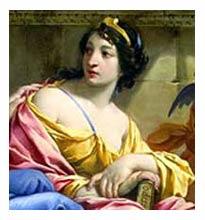
Calliope was the eldest and wisest of the 9 Muses. She was the most excellent Muse of all, accompanying respectable royalties on their way.
Calliope was the favorite Muse of the Greek poet Homer, many even consider Calliope being the actual mother of Homer. Another child of Calliope was said to have been Orpheus, a famous musician and poet in ancient Greece.
In depictions Calliope can be seen crowned with gold, holding a writing tablet or a volume of Homer's Odyssey in her hand.
2. Clio (History)
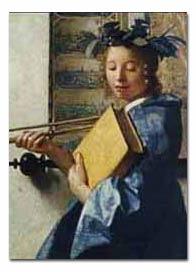
Muse Clio(Cleio) was the goddess of epic poetry and history and is also considered to be the inventor of the guitar.
Clio once fell madly in love with the King of Macedonia, Pierus and with Pierus she created the beautiful Hyacinth, the lover of Greek god Apollo.
Clio is often depicted dressed in purple with laurels on her hair, in the one hand holding a cornet and in the other a book, the book Cleio used to write history.
3. Erato (Love Poetry)
Erato was the Muse of lyric love poetry, hymns and wedding songs

Erato was the Muse and defender of love affairs and its said that she was the one who actually invented the art of dancing.
Erato is mostly depicted holding a guitar in her hands
4. Euterpe (Music)
Euterpe, the so-called "Giver of Pleasure", was the Muse of Music.

At classical times, Euterpe became also associated with Lyric Poetry and sometimes Sports. Euterpe was mainly depicted holding a flute.
When the Greek river Strymon once lied with Euterpe, Euterpe brought to life a son with the name Rhesus. Rhesus was a hero of Homer' s Iliad, who was killed by Greek hero Diomedes during the Trojan War.
5. Melpomene (Tragedy)

As her name suggests, Melpomene was the Muse of "Molpe", i.e. the divine intonation. However, Melpomene was mainly considered as the Muse of Tragedy.
Melpomene was usually portrayed with a tragic mask, although sometimes she was also presented wearing with buskins and a crown of wine leaves on her hair.
6. Polyhymnia (Hymns)
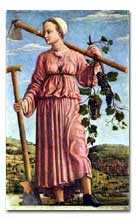
Polyhymnia was the Muse of the divine hymns, sacred poetry, geometry and mimetism.
Polyhymnia is often depicted like a very strict and thinking deity, with a wrath of daphne in her hair, looking up to the sky and expressing herself with gestures while playing the lyre.
7. Terpsichore (Dance)

As her name suggests("terpo"=delight + "chorus"=dance), Terpsichore was the Muse of the Dance and the Dramatic Chorus. Most of the times,Terpsichore was depicted playing a lyre, while other symbols of hers included the triangle and the flute.
Terpsichore was also consideed to have been the mother of the divine singing Sirens.
8. Thaleia (Comedy)
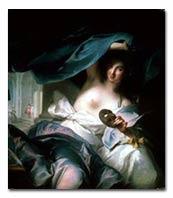
Thaleia was the Greek Muse of Comedy
Thaleia was the Greek Muse of comedy and pastoral poetry. She had eyes that flowed love and is often depicted holding a comic mask. The main attribute of Thalia was a shepherd's crook.
According to some mythologists claim that Thaleia was also the Muse of vegetation, interpreting from the origin of her name "thalo", i.e. "bloom".
9. Urania (Astronomy)
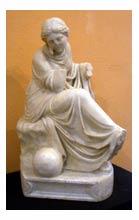
Urania was the muse of Astronomy and Astrology as she was able to foretell the future by the position of the stars. Urania was also a defender of love passion.
Oftentimes Urania was depicted holding a globe in her hands.
Myths about Muses
The Gift of the Muses to Mankind
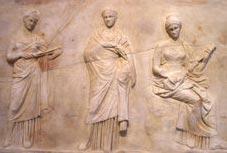
The Muses gave mankind a special kind of gift; the gift of talent and inspiration.
Blessed was the mortal whom the Muses happened to favor. On his birth, they would pour delicate dew on his tongue so that gentle words could come out of his mouth. All nations would then hang on his lips, respect him and treat him like a god, since only his decisions would result to justice and put an end to hassles.
It were the Muses who once blessed a shepherd named Hesiod with the gift of poetry, asking from him to rhapsodize the mankind's past and the future and praise the Muses like no other deity. Hesiod became one of the most significant writers of Ancient Greece and always remembered to refer to the Muses in a very comprehensive way
To anyone who was in mourning or falling into decay, the Muses would sympathize and sent out a singer to praise the glory of gods and mortals; immediately, the sad one would forget about his sorrow and would turn happy again by listening to the blessed sweet voice.