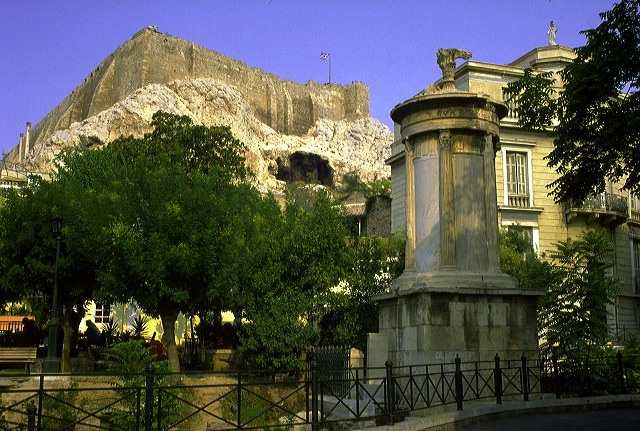
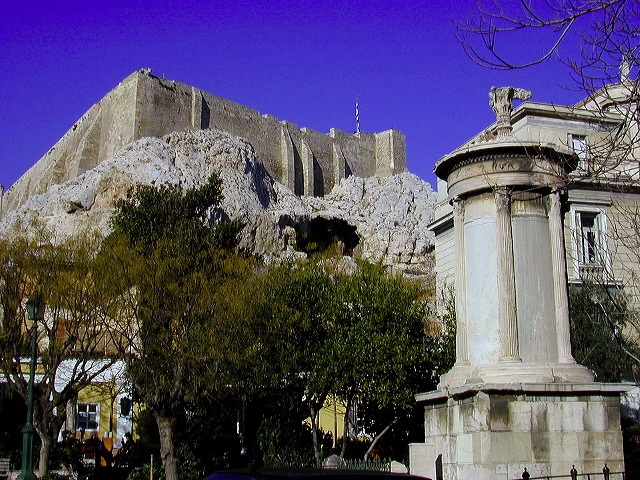
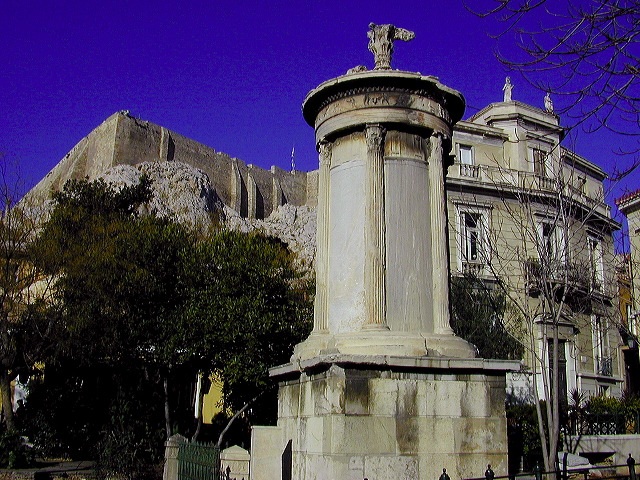
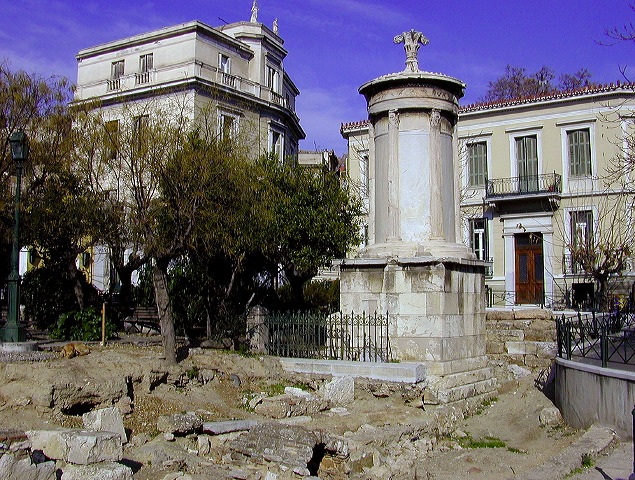
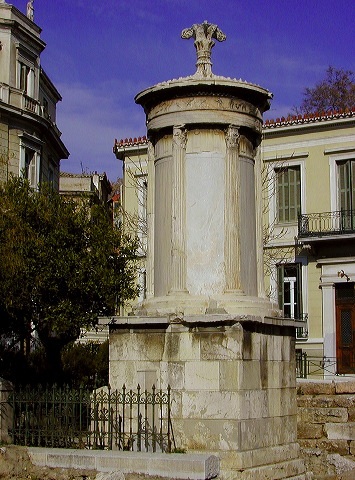
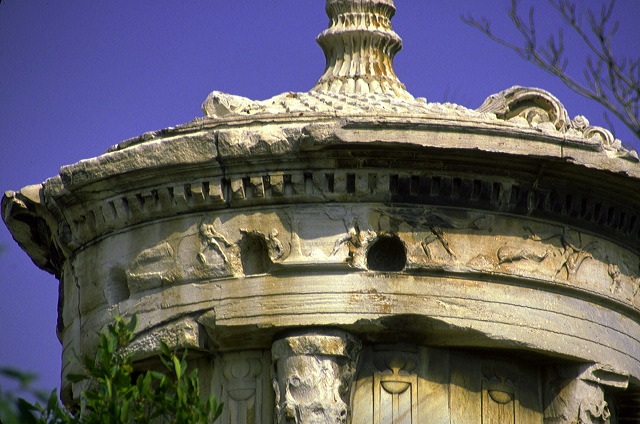
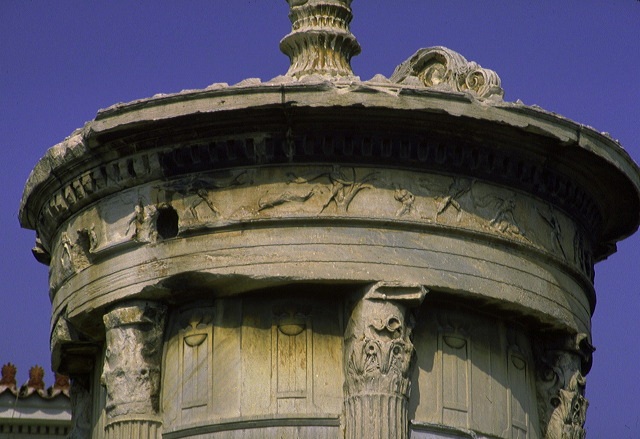
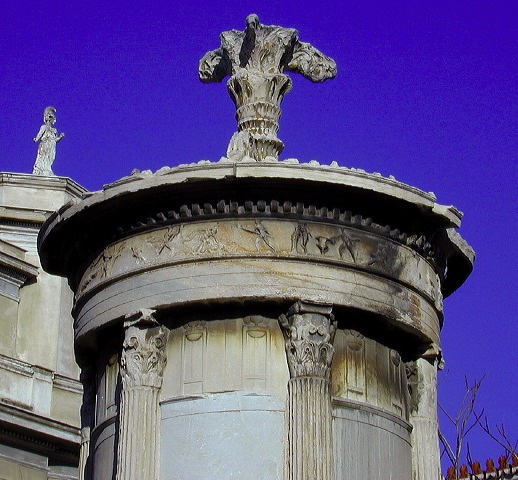
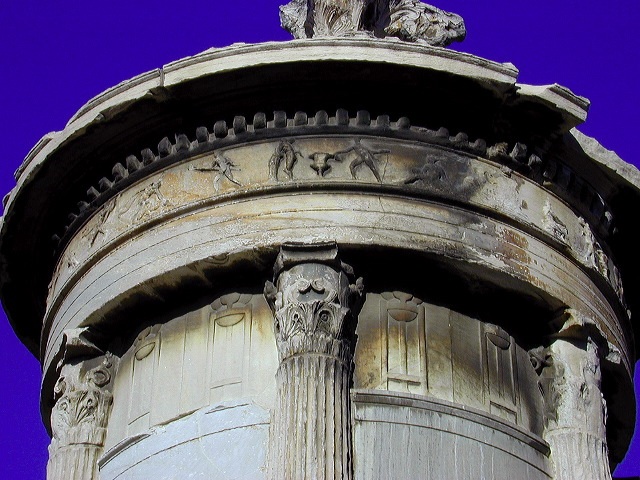
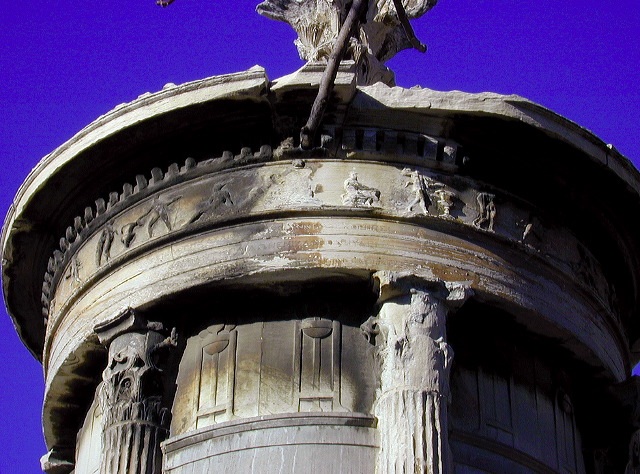
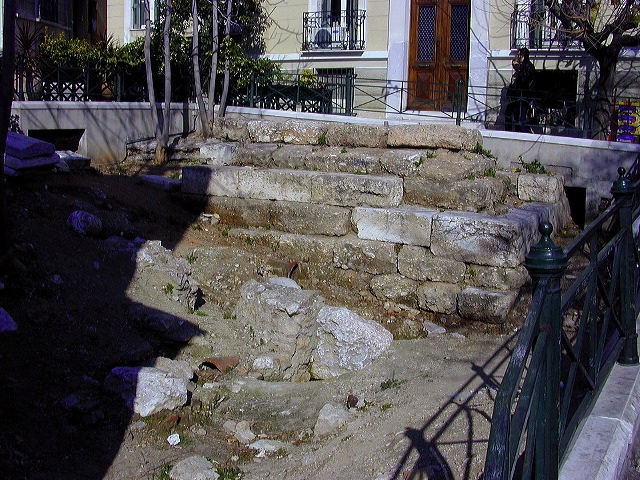
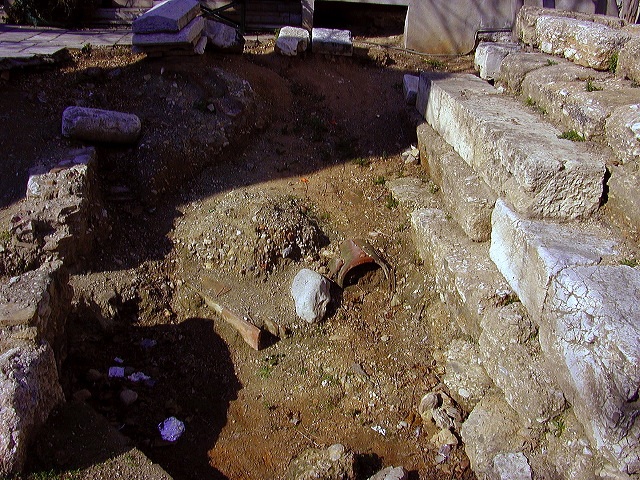
The Lysikrates Monument is the best preserved example of a choregic monument. Wealthy Athenian citizens financed the training and outfitting of choruses for competitive dramatical and musical performances. The producer (called the "choregos") assumed this expense as part of his civic and religious duty (an ancient "liturgy" called the "choregia"). The winning producer was awarded a bronze tripod. These tripods were displayed either in or near the sanctuary of Dionysos on the South Slope of the Acropolis or along the Street of the Tripods, an ancient road that led from the sanctuary of Dionysos around the east and northeast sides of the Acropolis. The tripods were set up on bases and other small structures inscribed with the names of the producer/choregos, the victorious Athenian tribe, the musician who accompanied the performance, the poet who "taught" the chorus, and the name of the Athenian magistrate at the time. The Lysikrates Monument was constructed on the western side of the Street of the Tripods in order to commemorate a choral victory in 335/334 B.C. (In the Middle Ages, the monument also acquired the nickname "Lantern of Demosthenes" from the erroneous belief that the 4h century orator composed his speeches there.).
The Lysikrates Monument (335/334 B.C.). This is the best preserved example of a choregic monument. Wealthy Athenian citizens financed the training and outfitting of dramatic and choral performances as a civic and religious duty (called a "leitourgia" or "liturgy"). A choregos" (producer) of a victorious choral competition (in honor of the god Dionysos) was awarded a bronze tripod (an ancient "Oscar"). Instead of keeping this award at home, as we would do today, the choregos put it on public display, either in the sanctuary of Dionysos or on the Street of the Tripods. The tripod could be displayed on a small and relatively simple base or on a more elaborate monument, frequently designed to look like a small building or even a temple. On the Lysikrates Monument, the bronze tripod would have been displayed on top of the roof. The Street of the Tripods, extending from the sanctuary of Dionysos on the South Slope and curving around the east and northeast side of the Acropolis, was lined with these impressive monuments. In the background is the East Slope of the Acropolis, with the East Cave. View from the east.The Lysikrates Monument (335/334 B.C.). Another photo from the east, on a cold winter day. Photo taken February 6, 2000.The Lysikrates Monument (335/334 B.C.). Another photo from the east, on a cold winter day. Photo taken February 6, 2000.The Lysikrates Monument (335/334 B.C.). In the foreground are the remains of a Late Antique sewer system that was built on top of the foundations of other choregic monuments on the Street of the Tripods. In the Middle Ages, the monument also acquired the nickname "Lantern of Demosthenes" from the (erroneous) belief that the great 4th century B.C. orator used to compose his speeches here. The Lysikrates monument is so well-preserved today because it was at one time built into a monastery. View from the southeast. Photo taken January 30, 2000.The Lysikrates Monument (335/334 B.C.). The monument consists of a tall limestone base (c. 4 meters tall), that is crowned with a cornice (a projecting ledge) of darker Eleusinian marble. Above this cornice, there are three steps of bluish marble from Mt. Hymettos. On top of the steps, most of the superstructure was made from Pentelic marble: 6 Corinthian columns, entablature (architrave, frieze and cornice), domed roof, and finial. Between the Corinthian columns were placed curved slabs of bluish Hymettian marble. The tall, projecting finial on the top would have supported the bronze tripod won by Lysikrates. It is also important to note that the Corinthiann columns on the building are the very first preserved examples of the Corinthian order used on the exterior of a Greek building. There is a debate about whether the interior of the building was ever meant to be seen. One current hypothesis is that the central (east) curved panel was only added later, and that the orginal design included a statue (of Dionysos?) in the interior that could be seen from the Street of the Tripods. View from the southeast. Photo taken January 30, 2000.The Lysikrates Monument (335/334 B.C.). Detail of the entablature on the south side. At the bottom , you can see the worn Corinthian capitals and the curved slabs of Hymettian marble between the columns. At the top of each slab were tripods carved in relief, symbols of victory. Above the capitals is the architrave (or epistyle), here carved in 3 horizontal bands (a triple-fascia). Above the architrave is a frieze carved in a continuous band of relief decoration. The frieze depicts a story from Greek myth: the god Dionysos and the Tyrrhenian pirates (whom he turned into dolphins). If you look carefully, you can see on the transformed pirates on the right side. Most scholars believe that this story was the subject of the winning choral perfomance produced by Lysikrates (although we do not have direct evidence to prove it). Above the sculpted frieze is another small frieze of dentils, here carved togetherwith a the cornice (or geison). The domed roof of the building is one block of Pentelic marble, carved in a leaf pattern on top. In the center is the finial, carved with the leaves of an acanthus plant, which supported the bronze tripod.The Lysikrates Monument (335/334 B.C.). Just to the left of center in the frieze, you can see one of the pirates being transformed into a dolphin. View from the south.The Lysikrates Monument (335/334 B.C.). View from the southeast. Photo taken February 6, 2000.The Lysikrates Monument (335/334 B.C.). View from the southeast. Photo taken February 6, 2000.The Lysikrates Monument (335/334 B.C.). This was the front of the building and the side meant to be seen directly from the Street of the Tripods. In the center of the architrave, between the two columns, is an ancient inscription: "Lysikrates of Kikyna, son of Lysitheides, was choregos; the tribe of Akamantis won the victory with a chorus of boys; Theon played the flute; Lysiades of Athens trained the chorus; Euainetos was archon" (IG II2 3042). Among the many specific details we learn from this inscription is the date of the victory (and presumaby the building). Based upon lists of Athenian eponymous archons (magistrates after whom the entire year was named), we can calculate that Euainetos was archon in 335/334 B.C. (that is, the Athenian year that began in August 335 B.C. of our modern calendar and lasted until 334 B.C.). It is rare for us to have such a specific date for an ancient monument. Note also what the ancient considered important to record in the inscription: the choregos (producer) who provided the funds, the tribe, the type of chorus, the name of the musician, the name of the poet (who trained or "taught" the chorus, and the city official who was in charge that year. The subject of the choral performance is NOT recored, but most people think it must have been the same story (Dionysos and the pirates) depicted in the frieze. View from the east. Photo taken February 6, 2000.Street of the Tripods. The foundations of another large choregic monument to the north of the Lysikrates Monument. Excavations in the basements of building along modern Odhos Tripodhon have uncovered other foundations, too. The extent of the Street of the Tripods has important topographical implications for locating other monuments, sanctuaries, and public buildings of ancient Athens (suhc as the Prytaneion). Some scholars feel that the Street of the tropids extended only as far as the northeastern side of the Acropolis, while others think that it extended farther along the north slope, possible as far as the City Eleusinion. At present, there is no definitive answer. BUT, excavations (mostly in the basements of houses and no longer visible) by the Greek archaeological service on the north side of the Acropolis (in the area of the old Capodistrian University) have discovered more foundations that closely resemble the ones seen here. Photo taken January 30, 2000.Street of the Tripods. At right ar the stepped foundations of another large choregic monument to the north of the Lysikrates Monument. In the center of the photo is a narrow ancient street that ran to the east from the Street of the Tripods. Note the terracotta drain pipe. Photo taken January 30, 2000.
Included here are articles that deal with aspects of specific New Testament Books or passages, but does not include Lectionary Commentary articles. For more general articles on the New Testament, see Bible Topics, Issues in Biblical Interpretation, Biblical Theology, The Bible in the Church, and Hi...
Read More
Included here are articles that deal with aspects of specific Old Testament Books or passages, but this does not include Lectionary Commentary articles. For more general articles on the Old Testament, see Bible Topics, Issues in Biblical Interpretation, Biblical Theology, The Bible in the Church, a...
Read More
DefinitionLiterary StyleSynoptic GospelsSynoptic ProblemThe ProblemProposed SolutionsTheory of Mutual DependenceTheory of Documentary HypothesisTheory of Oral TraditionEclectic ViewWhy SimilaritiesWhy Diferences?Definition
The Term Gospel comes from an old Anglo-Saxon word godespel meaning God's tid...
Read More
37 B.C.–4 B.C. - The reign of Herod I, a Roman client king of Israel27 B.C.-14 A.D. - The reign of Caesar Augustus, the first emperor of the Roman Empirec. 6 B.C. - The birth of Jesus26-36 A.D. - Pontius Pilate the Prefect of the Roman Empire's Judaea Provincec. 30-33 - The death and resurrection o...
Read More
Description
The term miracle is a general term used to describe extraordinary workings of God in the world during certain times of man's history. However there are several terms used in Greek and Hebrew to describe what is commonly called miracle.
Miracles of Jesus
Miracles of Elisha
Marvellous Work...
Read More
The New Testament, a cornerstone of Christian theology, is a collection of 27 books that provide insight into the life, teachings, and resurrection of Jesus Christ. Each book was written by different authors, offering unique perspectives on the early Christian faith. Let's embark on a journey to exp...
Read More
Free Unicode fonts and keyboards
Unicode fonts are now becoming standard, and they are easy to use with the free Tyndale Unicode Font Kit.
Almost all word processors now support unicode - with the notable exceptions of Word Perfect on the PC and Word on the Mac before Word 2004. If you use Windows 9...
Read More
Mac Korean
Mac Korean is a bit-mapped suitcase that contains the fonts named Inchon, KSL, Pusan and Seoul. With these fonts you can write in Korean without the Korean Language Kit or HanTalk. [Thanks to S. Todd Stubbs and Sol Yang Hwan of BYU for the instructions included with these fonts.]
Downloa...
Read More
Column 1
In the ruins which are in the Valley of Achor, under
the steps which go eastward, forty
rod-cubits: a strongbox of silver and its vessels
- a weight of seventeen talents. KEN
in the sepulchre of Ben Rabbah the Third: 100 ingots of
gold. In the big cistern in the court of
the peristyle, in a...
Read More
The Book of Secrets
1Q27, 4Q299-301
4Q301 F1
(...) I shall speak out freely, and I shall express my various sayings among you (...) (.. those who would understand parables and riddles, and those who would penetrate the origins of knowledge, along with those who hold fast to the wonderful mysteries ....
Read More
The present work was evidently intended to govern a ritual of baptism or ablutions. A sectarian text by virtue of its mention of the Yachad, this liturgy may have operated during the ritual washings that are discussed in the Charter (see text 5, 3:4-9; 4:21; 5:13b-14). The Liturgy's distinctive form...
Read More
1Q29
F.1
(...) (...) the stone, just as the LORD commanded ....) and your Urim. And it (the cloud?) shall come forth with him, with the tongues of fire. The left-hand stone which is on its left side shall be uncovered before the whole congregation until the priest finishes speaking and after the clo...
Read More
Col.2
(...) And concerning what Scripture says, "In this year of Jubilee you shall return, everyone f you, to your property" (Lev. 25;13) And what is also written; "And this is the manner of the remission; every creditor shall remit the claim that is held against a neighbor, not exacting it of a nei...
Read More
Psalm 4.
I thank you, O Lord,for your eye is awake and watches over my soul.You rescue me from the jealousy of liars,from the congregation of those who seek the smooth way.But you save the soul of the poorwhom they planned to destroyby spilling the blood of your servant.
I walked because of you - bu...
Read More
F.1 Col.2
Please consider this, you who are wise: If a man has a fine tree, which grows high, all the way to heaven (...) (...) of the soil, and it produces succulent fruit every year with the autumn rains and the spring rains, (...) and in thirst, will he not (...) and guard it (...) to multiply th...
Read More
After 1380 B.C.Jebus, the original name of ancient Jerusalem, is populated by the Jebusites (a Canaanite tribe). It is a city built on seven hills. A partial siege carried out by the tribe of Judah against the city (Judges 1:8) takes place a short time after the death of Joshua.
1010David begins his...
Read More