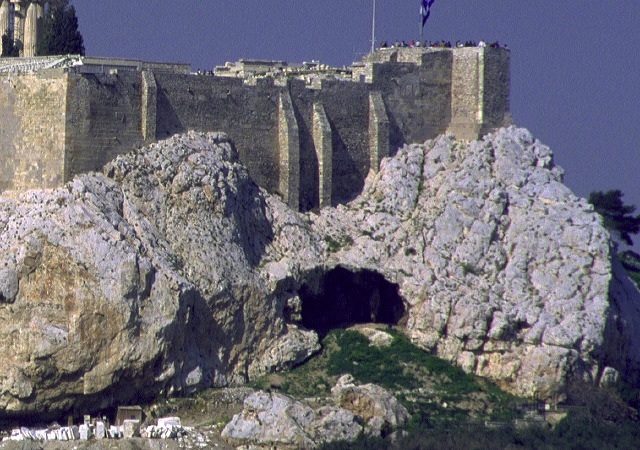
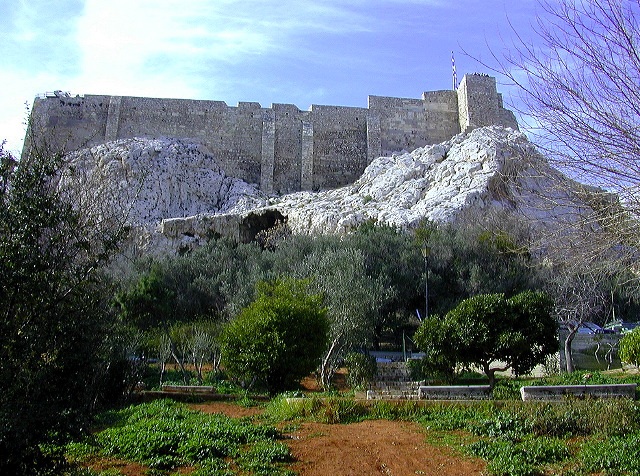
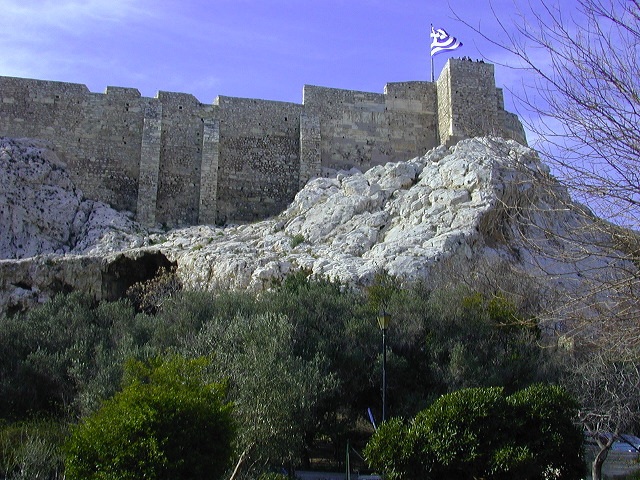
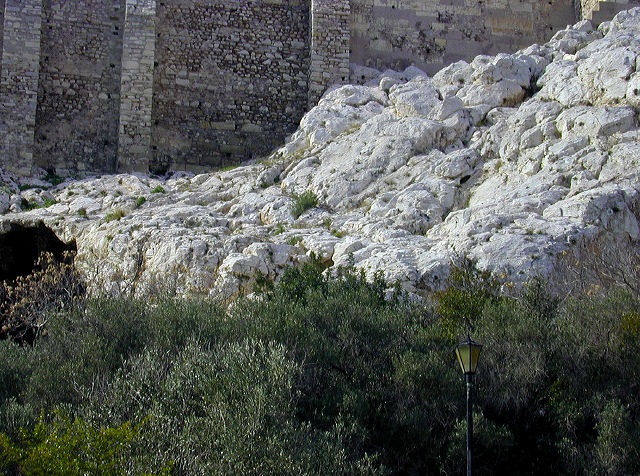
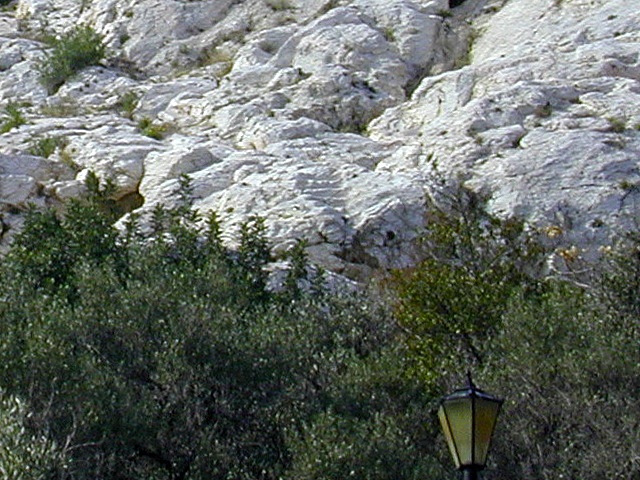
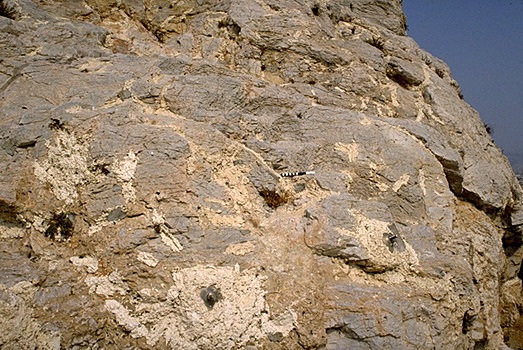
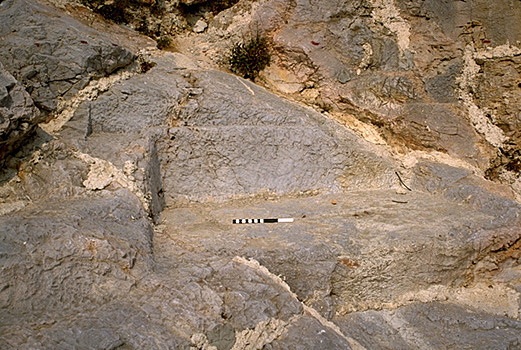
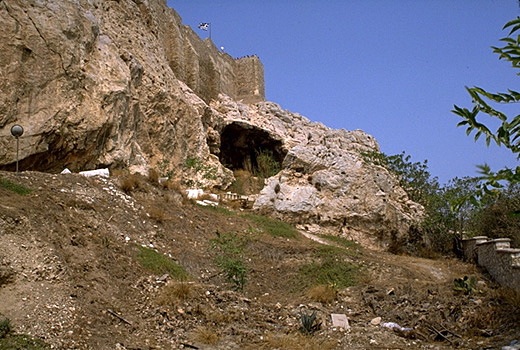
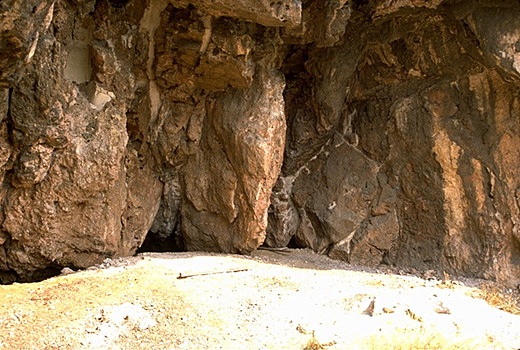
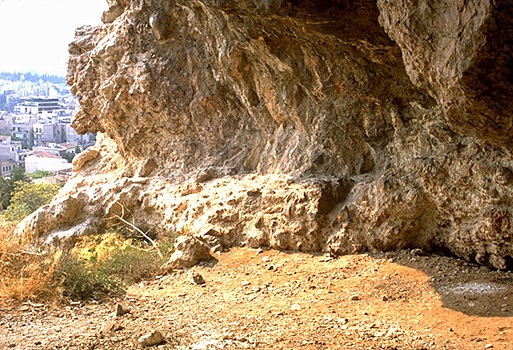
The East Slope of the Acropolis is an area that has not (yet) been the focus of a great deal of archaeological investigation. Early travelers and explorers noted, of course, the very large and prominent East Cave that forms such a distinctive landmark and speculated that it must have been used as a sanctuary in antiquity. (One early -- and incorrect -- hypothesis was that it was the City Eleusinion). The interior of the East Cave was briefly explored by O. Broneer in 1936, but it was found that the earth had been disturbed in (relatively) modern times and that no ancient levels were preserved. Outside of the cave, Broneer located a rock-cut bedding for an ancient stele. On the steep cliff north of the stele bedding, Broneer also discovered some rock-cut steps leading to a rectangular bedding, probably for an altar, demonstrating that the area did have some importance in antiquity.
In 1980, an ancient, inscribed stele was discovered a good distance downslope from the East Cave. The inscription dates to the 3rd century B.C., and records honors awarded by the Athenians to a priestess of the heroine Aglauros. The inscription also specifically states that the stele was to be set up "in the shrine of Aglauros". Since the stele was found intact and still attached to its base, G. Dontas argued that it was still in its original location and that the Aglaureion was on the East Slope. Until the discovery of this inscription, almost all scholars had thought that the shrine of Aglauros was on the North Slope (the most popular candidate was at the old Mycenaean Fountain). If the "true Aglaureion" was on the East Slope, then the location of several other unexcavated shrines (such as the Anakeion) attested in ancient literary sources as being near the Aglaureion must also be shifted to the east. We also know from Herodotus that the Persians scaled the Acropolis rock from somewhere near the Aglaureion when they captured and destroyed the citadel in 480 B.C.
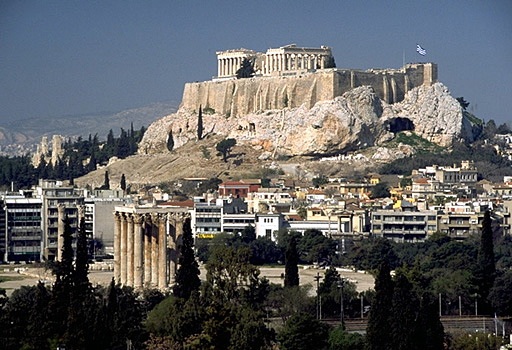
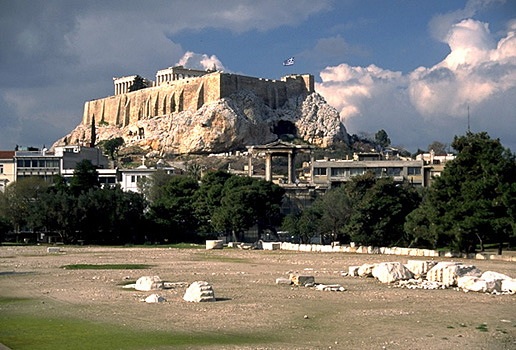
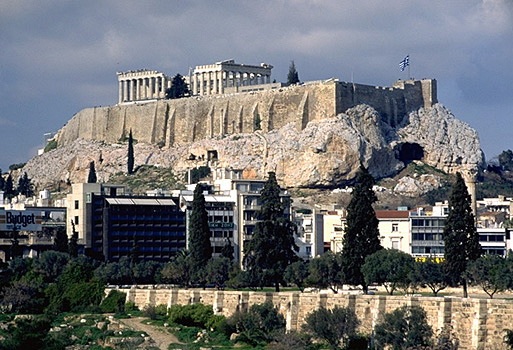
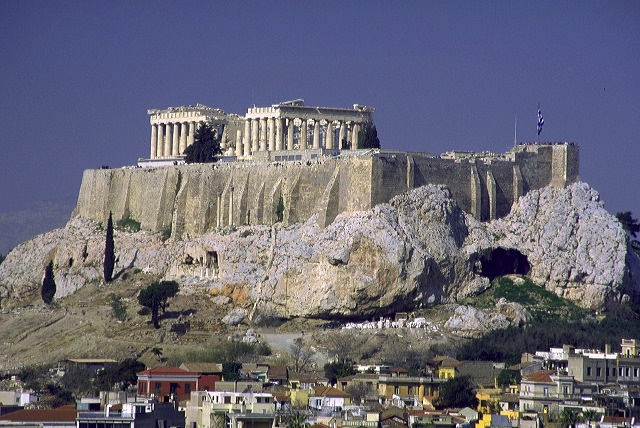
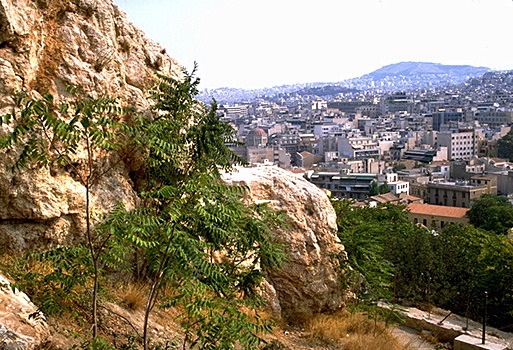
View of the Acropolis, its South and East Slopes, and the Olympieion from the Ardettos Hill. Especially prominent is the large East Cave. Note also the steep, projecting spur of rock immediately to the right of the East Cave. This is one of the steepest parts of the Acropolis and it is one of the candidates for the spot where the Persians finally scaled the citadel in 480 B.C. View from the southeast.View of the Acropolis and the East Slope from the Olympieion. In the foreground near the center of the picture, immediately below the East Cave, is the Arch of Hadrian.View of the Acropolis and the South and East Slopes from the "Temple on the Ilissos." The wall in the foreground is part of the precinct wall surrounding the Olympieion.View of the Acropolis and the South and East Slopes from the the southeast.The East Slope of the Acropolis. Detail of the preceding photo. View from the southeast.The East Slope of the Acropolis. The East Cave is near the center of the photo. View from the east. Photo taken January 30, 2000.The East Slope of the Acropolis. The cliffs on the north (right) side of the East Cave are very steep. In 1933, O. Broneer discovered some rock-cut steps that are visible in this photo, just to the right of center. (Find the street light. Follow the line of the street light straight up, to the top of the trees. The steps are visible just above the trees, to the left. ). View from the east. Photo taken January 30, 2000.The East Slope of the Acropolis. Detail showing the East Cave and the cliffs to the north (right). The rock-cut steps are visible just to the right of center in the photo. View from the east. Photo taken January 30, 2000.The East Slope of the Acropolis. Detail of the rock-cut steps discovered by O. Broneer. The steps are right in the center of the photo. There are 10 steps leading up to a larger cutting that Broneer felt was for an altar. The cliff-face in front of the steps is highly fractured, so that it is unknown if the steps originally continued down to the level of the Peripatos Path. Today, it is very steep. View from the east. Photo taken January 30, 2000.Rock-cut steps to the northeast of the East Cave. On the projecting spur of rock to the northeast of the East Cave, O. Broneer also discovered (in 1933) a series of rock-cut steps leading to a spot where the rock had been trimmed down as a bedding for a large rectangular monument, probably an altar. The steps are a little hard to see in this photo. The 20cm scale is resting on one of the steps. The next step is about 20cm above it, ascending to the left.Detail of the rock-cut steps and "altar bedding" to the northeast of the East Cave. Although this monument or altar no longer survives, these cuttings indicate that this area had some importance in ancient times.View of the East Slope of the Acropolis and the East Cave from the southeast. The large, sloping depression in the central foreground marks the spot of the trench excavated by Oscar Broneer and the American School of Classical Studies in 1939. Within this trench Broneer found a marble-paved road running east-west and aligned with the upper diazoma of the Theater of Dionysos. It is likely that this road, paved in the Roman period, formed part of a processional way leading from the Street of the Tripods (to the east) up to the Theater. The outbreak of World War II prevented Broneer from exploring this road in any detail, and the trench has now been partially filled with earth.Inside the East Cave. View of the rear of the cave, from the east. While it is likely that this prominent cave had some special significance in antiquity, there is now very little evidence preserved to tell us what this significance was. For example, there are no niches or other rock cuttings inside the cave to prove that it was used as a sanctuary (like the caves of Apollo and Pan on the north slope). O. Broneer excavated two test trenches in the cave in 1936, and found that the earth inside had all been disturbed.Inside the East Cave. View of the left (southern) side from the north.View to the northeast from the mouth of the East Cave.
Included here are articles that deal with aspects of specific New Testament Books or passages, but does not include Lectionary Commentary articles. For more general articles on the New Testament, see Bible Topics, Issues in Biblical Interpretation, Biblical Theology, The Bible in the Church, and Hi...
Read More
Included here are articles that deal with aspects of specific Old Testament Books or passages, but this does not include Lectionary Commentary articles. For more general articles on the Old Testament, see Bible Topics, Issues in Biblical Interpretation, Biblical Theology, The Bible in the Church, a...
Read More
DefinitionLiterary StyleSynoptic GospelsSynoptic ProblemThe ProblemProposed SolutionsTheory of Mutual DependenceTheory of Documentary HypothesisTheory of Oral TraditionEclectic ViewWhy SimilaritiesWhy Diferences?Definition
The Term Gospel comes from an old Anglo-Saxon word godespel meaning God's tid...
Read More
37 B.C.–4 B.C. - The reign of Herod I, a Roman client king of Israel27 B.C.-14 A.D. - The reign of Caesar Augustus, the first emperor of the Roman Empirec. 6 B.C. - The birth of Jesus26-36 A.D. - Pontius Pilate the Prefect of the Roman Empire's Judaea Provincec. 30-33 - The death and resurrection o...
Read More
Description
The term miracle is a general term used to describe extraordinary workings of God in the world during certain times of man's history. However there are several terms used in Greek and Hebrew to describe what is commonly called miracle.
Miracles of Jesus
Miracles of Elisha
Marvellous Work...
Read More
The New Testament, a cornerstone of Christian theology, is a collection of 27 books that provide insight into the life, teachings, and resurrection of Jesus Christ. Each book was written by different authors, offering unique perspectives on the early Christian faith. Let's embark on a journey to exp...
Read More
Free Unicode fonts and keyboards
Unicode fonts are now becoming standard, and they are easy to use with the free Tyndale Unicode Font Kit.
Almost all word processors now support unicode - with the notable exceptions of Word Perfect on the PC and Word on the Mac before Word 2004. If you use Windows 9...
Read More
Mac Korean
Mac Korean is a bit-mapped suitcase that contains the fonts named Inchon, KSL, Pusan and Seoul. With these fonts you can write in Korean without the Korean Language Kit or HanTalk. [Thanks to S. Todd Stubbs and Sol Yang Hwan of BYU for the instructions included with these fonts.]
Downloa...
Read More
Column 1
In the ruins which are in the Valley of Achor, under
the steps which go eastward, forty
rod-cubits: a strongbox of silver and its vessels
- a weight of seventeen talents. KEN
in the sepulchre of Ben Rabbah the Third: 100 ingots of
gold. In the big cistern in the court of
the peristyle, in a...
Read More
The Book of Secrets
1Q27, 4Q299-301
4Q301 F1
(...) I shall speak out freely, and I shall express my various sayings among you (...) (.. those who would understand parables and riddles, and those who would penetrate the origins of knowledge, along with those who hold fast to the wonderful mysteries ....
Read More
The present work was evidently intended to govern a ritual of baptism or ablutions. A sectarian text by virtue of its mention of the Yachad, this liturgy may have operated during the ritual washings that are discussed in the Charter (see text 5, 3:4-9; 4:21; 5:13b-14). The Liturgy's distinctive form...
Read More
1Q29
F.1
(...) (...) the stone, just as the LORD commanded ....) and your Urim. And it (the cloud?) shall come forth with him, with the tongues of fire. The left-hand stone which is on its left side shall be uncovered before the whole congregation until the priest finishes speaking and after the clo...
Read More
Col.2
(...) And concerning what Scripture says, "In this year of Jubilee you shall return, everyone f you, to your property" (Lev. 25;13) And what is also written; "And this is the manner of the remission; every creditor shall remit the claim that is held against a neighbor, not exacting it of a nei...
Read More
Psalm 4.
I thank you, O Lord,for your eye is awake and watches over my soul.You rescue me from the jealousy of liars,from the congregation of those who seek the smooth way.But you save the soul of the poorwhom they planned to destroyby spilling the blood of your servant.
I walked because of you - bu...
Read More
F.1 Col.2
Please consider this, you who are wise: If a man has a fine tree, which grows high, all the way to heaven (...) (...) of the soil, and it produces succulent fruit every year with the autumn rains and the spring rains, (...) and in thirst, will he not (...) and guard it (...) to multiply th...
Read More
After 1380 B.C.Jebus, the original name of ancient Jerusalem, is populated by the Jebusites (a Canaanite tribe). It is a city built on seven hills. A partial siege carried out by the tribe of Judah against the city (Judges 1:8) takes place a short time after the death of Joshua.
1010David begins his...
Read More