The Agora, the marketplace and civic center, was one of the most important parts of an ancient city of Athens. In addition to being a place where people gathered to buy and sell all kinds of commodities, it was also a place where people assembled to discuss all kinds of topics: business, politics, current events, or the nature of the universe and the divine. The Agora of Athens, where ancient Greek democracy first came to life, provides a wonderful opportunity to examine the commercial, political, religious, and cultural life of one of the great cities of the ancient world.
The earliest archaeological excavations in the Athenian Agora were conducted by the Greek Archaeological Society in the 19th century. Since 1931 and continuing to the present day, the excavations have been conducted by the American School of Classical Studies in Athens.
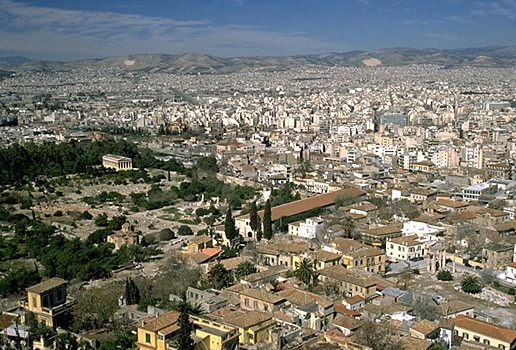
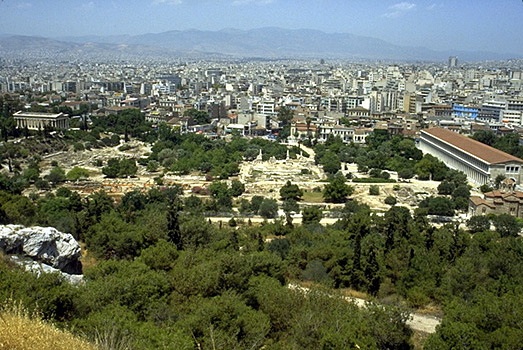
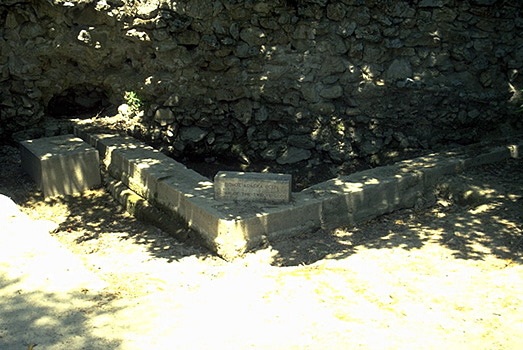
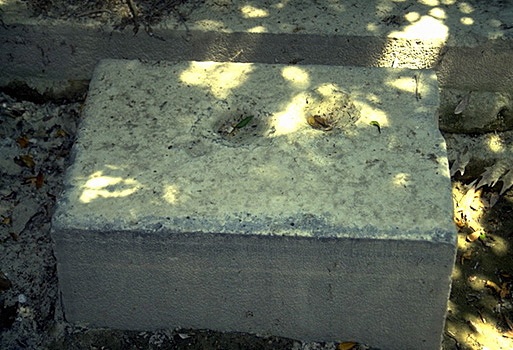
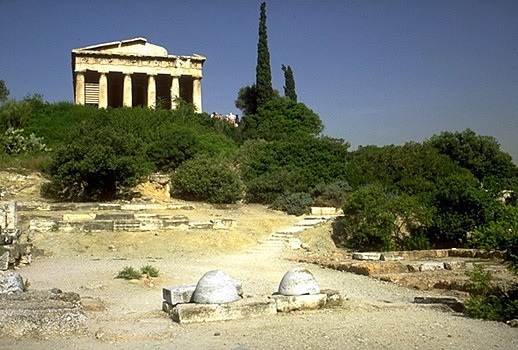
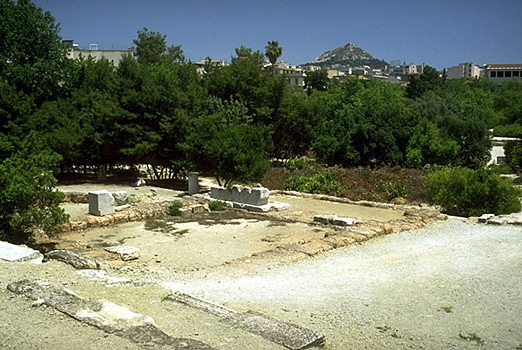
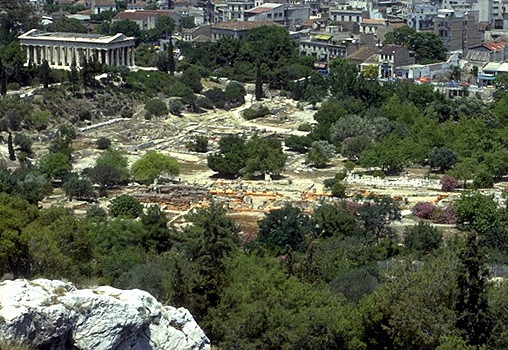
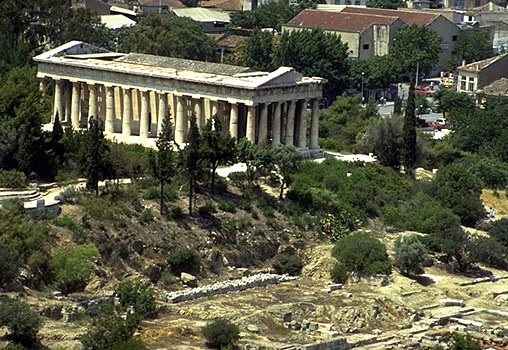
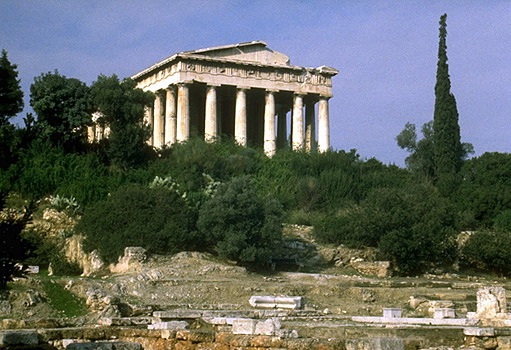
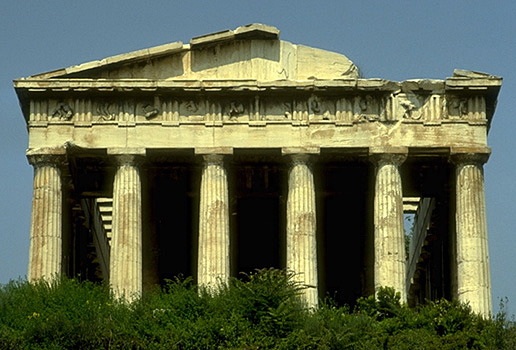
View of the Agora from the Acropolis (east of the Erechtheion). The Temple of Hephaistos is visible on the Kolonos Agoraios Hill on the left side of the photo, while the red tile roof of the Stoa of Attalos is just about in the center. Towards the lower right side of the photo you can also see the Gate of Athena Archegetis and the Roman Agora (Market of Caesar and Augustus). View from the southeast.The Athenian Agora, as seen from the Areopagus, looking north. On the left side of the photo is the Hephaisteion (Temple of Hephaistos) on the Kolonos Agoraios hill. On the right side is the Stoa of Attalos and the Church of the Holy Apostles. The Mt. Parnes range is in the background. View from the south.The Panathenaic Way and the Athenian Agora, looking toward the Acropolis. At the left side of the photo is the reconstructed Stoa of Attalos. On the right is one of the Giants from facade of the Odeion of Agrippa. The Acropolis is in the background. View from north.Altar of the Twelve Gods. Originally constructed 522/1 B.C., but with later rebuilding and repairs. View from the southwest. Only the southwestern corner of the altar is visible (the rest of the monument is actually underneath the electric railway to the north). What we see in the photos is only a low sill with cuttings and holes to attach a slabs and posts of a stone fence that once surrounded the altar. The original entrance to the altar (now hidden by the railway wall) was just to the left of the marble statue base (far left in the photo). The Altar of the Twelve Gods was considered to be the very center of the ancient city of Athens, and it was the "zero mile marker" from which distances were measured.The Leagros Base, in front of the Altar of the Twelve Gods. View from the west. The base is made of marble. The cuttings on the top surface tell archaeologists that the base originally supported a bronze statue. The inscription across the front reads "Leagros, the son of Glaukos, dedicated [the statue] to the Twelve Gods."Stoa of Zeus Eleutherios on the west side of the Agora, looking southwest. The stoa was built in around 425 B.C. It had one storey, with Doric columns on the exterior and Ionic columns on the interior. The stoa also had two projecting wings, one at north and one at south. The northern wing was mostly destroyed during the construction of the modern railway.This photo shows a detail of two rooms added the back of the stoa in the Roman period. The Hephaisteion is above. View from the northeast.Stoa of Zeus Eleutherios. View of the two back rooms added during the Roman period, looking to the northeast.West side of the Agora, looking west. On the top of Kolonos Agoraios hill is the Hephaisteion (Temple of Hephaistos). Barely visible at left is the northern edge of the Metroon. At right, the orange-red foundations belong to the Temple of Apollo Patroos. View from the east.The foundations of the Temple of Apollo Patroos. View from the southeast.Temple of Apollo Patroos, looking northeast. The conical peak in the background is Mt. Lykabettos. View from the southwest.The Athenian Agora, as seen from the Areopagus, looking north. Detail showing the Hephaisteion (Temple of Hephaistos) on the Kolonos Agoraios hill and the western side of the Agora excavations. View from the south.The Hephaisteion (Temple of Hephaistos). View from the Areopagus, looking northeast.The Hephaisteion (Temple of Hephaistos) in the Athenian Agora. View of the front (east) and north side of the temple from the areas of the Metroon.The Hephaisteion (Temple of Hephaistos) in the Athenian Agora. View of the front (east side).The Hephaisteion (Temple of Hephaistos). View from the southeast.
Included here are articles that deal with aspects of specific New Testament Books or passages, but does not include Lectionary Commentary articles. For more general articles on the New Testament, see Bible Topics, Issues in Biblical Interpretation, Biblical Theology, The Bible in the Church, and Hi...
Read More
Included here are articles that deal with aspects of specific Old Testament Books or passages, but this does not include Lectionary Commentary articles. For more general articles on the Old Testament, see Bible Topics, Issues in Biblical Interpretation, Biblical Theology, The Bible in the Church, a...
Read More
DefinitionLiterary StyleSynoptic GospelsSynoptic ProblemThe ProblemProposed SolutionsTheory of Mutual DependenceTheory of Documentary HypothesisTheory of Oral TraditionEclectic ViewWhy SimilaritiesWhy Diferences?Definition
The Term Gospel comes from an old Anglo-Saxon word godespel meaning God's tid...
Read More
37 B.C.–4 B.C. - The reign of Herod I, a Roman client king of Israel27 B.C.-14 A.D. - The reign of Caesar Augustus, the first emperor of the Roman Empirec. 6 B.C. - The birth of Jesus26-36 A.D. - Pontius Pilate the Prefect of the Roman Empire's Judaea Provincec. 30-33 - The death and resurrection o...
Read More
Description
The term miracle is a general term used to describe extraordinary workings of God in the world during certain times of man's history. However there are several terms used in Greek and Hebrew to describe what is commonly called miracle.
Miracles of Jesus
Miracles of Elisha
Marvellous Work...
Read More
The New Testament, a cornerstone of Christian theology, is a collection of 27 books that provide insight into the life, teachings, and resurrection of Jesus Christ. Each book was written by different authors, offering unique perspectives on the early Christian faith. Let's embark on a journey to exp...
Read More
Free Unicode fonts and keyboards
Unicode fonts are now becoming standard, and they are easy to use with the free Tyndale Unicode Font Kit.
Almost all word processors now support unicode - with the notable exceptions of Word Perfect on the PC and Word on the Mac before Word 2004. If you use Windows 9...
Read More
Mac Korean
Mac Korean is a bit-mapped suitcase that contains the fonts named Inchon, KSL, Pusan and Seoul. With these fonts you can write in Korean without the Korean Language Kit or HanTalk. [Thanks to S. Todd Stubbs and Sol Yang Hwan of BYU for the instructions included with these fonts.]
Downloa...
Read More
Column 1
In the ruins which are in the Valley of Achor, under
the steps which go eastward, forty
rod-cubits: a strongbox of silver and its vessels
- a weight of seventeen talents. KEN
in the sepulchre of Ben Rabbah the Third: 100 ingots of
gold. In the big cistern in the court of
the peristyle, in a...
Read More
The Book of Secrets
1Q27, 4Q299-301
4Q301 F1
(...) I shall speak out freely, and I shall express my various sayings among you (...) (.. those who would understand parables and riddles, and those who would penetrate the origins of knowledge, along with those who hold fast to the wonderful mysteries ....
Read More
The present work was evidently intended to govern a ritual of baptism or ablutions. A sectarian text by virtue of its mention of the Yachad, this liturgy may have operated during the ritual washings that are discussed in the Charter (see text 5, 3:4-9; 4:21; 5:13b-14). The Liturgy's distinctive form...
Read More
1Q29
F.1
(...) (...) the stone, just as the LORD commanded ....) and your Urim. And it (the cloud?) shall come forth with him, with the tongues of fire. The left-hand stone which is on its left side shall be uncovered before the whole congregation until the priest finishes speaking and after the clo...
Read More
Col.2
(...) And concerning what Scripture says, "In this year of Jubilee you shall return, everyone f you, to your property" (Lev. 25;13) And what is also written; "And this is the manner of the remission; every creditor shall remit the claim that is held against a neighbor, not exacting it of a nei...
Read More
Psalm 4.
I thank you, O Lord,for your eye is awake and watches over my soul.You rescue me from the jealousy of liars,from the congregation of those who seek the smooth way.But you save the soul of the poorwhom they planned to destroyby spilling the blood of your servant.
I walked because of you - bu...
Read More
F.1 Col.2
Please consider this, you who are wise: If a man has a fine tree, which grows high, all the way to heaven (...) (...) of the soil, and it produces succulent fruit every year with the autumn rains and the spring rains, (...) and in thirst, will he not (...) and guard it (...) to multiply th...
Read More
After 1380 B.C.Jebus, the original name of ancient Jerusalem, is populated by the Jebusites (a Canaanite tribe). It is a city built on seven hills. A partial siege carried out by the tribe of Judah against the city (Judges 1:8) takes place a short time after the death of Joshua.
1010David begins his...
Read More