Sparta
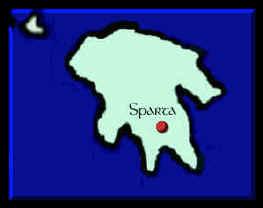
Sparta (also known as Lacedaemeon) is situated on the southern Pelloponesus, and was originally founded during the Dorian invasions. Where the Dorians had in some cities managed to emmesh themselves into a place of aristocratic neutrality with the general populace, in other cities, the Dorians held tight rule which relegated the native citizens to the status of serfs. Sparta was one such a city, where strict dominion was held over the city, and its occupants.
The city of Sparta was originally founded during and after the Messenean War, in which the Dorian Spartans crossed the Taygetus mountains and took the territory of the Messenia. However, the original occupants of Messenia did not easily submit to the Spartans rule, and thus, in 640 BC the Messeneans revolted. The revolt nearly defeated the Spartans, but they managed to hold strong and continued their rule over the Messenean region. However, obviously outnumbered by the native population of Messenia, and accompanied by other political stresses, the Spartans responded by enacting a military government, or a military oligarchy, formulated by Lycurgus. In such an oligarchic polis, the native population were relegated to the status of agricultural slavery, or helots, which only amounted to a life of meek serfdom.
Above the helots in status, were the perioeci. The perioeci were the traders, merchants, and foreigners of Spartan society, who were allowed a larger amount of freedom than the helots. Atop both the helots, and the perioeci, were the Spartiate. A Spartiate could trace their lineage through to the cities original Dorian occupants, was required to serve in the army, could vote, and were the only people who were allowed full political rights of the state itself.
Unlike Athens, Sparta was a military oligarchy, monarchy, democracy, and timocracy all rolled into one. Originally founded with aristocratic interest, Sparta managed to keep its lineage of kings through out its existence. The kings themselves came from two great aristocratic houses. From these two great houses and the aristocratic influence of early Sparta, the city survived under the edict of "dependence of the small on the great." The two kings (dual monarchy) of Sparta however held little rule over Sparta, rather it was the counsel below the kings, composed of 28 nobles (all past their mandatory service in the military), and the two kings which made many of the political decisions for Sparta. Just below the Counsel was the assembly of the Spartiate (composed of Spartan males). The assembly was run democratically and could veto or approve the rulings of the counsel above it. However, beyond the counsel, and beyond the assembly, was the Ephorate. The ephorate was a group of five men who practically guided all aspects of Spartan life. Along with ruling over the military, it held the power to veto any ruling made by the Counsel or the assembly. Regardless of how odd such a political system may seem in the twentieth century, and how opposite it may have been in comparison to the democracy of Athens, Spartan culture flourished through out the Aegean. Known almost exclusively for its military strength, and its role within the Persian Wars, the Spartans believed themselves to be of "true" Greek lineage and tradition. Their reign, extended with the aid of alliances and invasions, covered most of the pelloponesus, until the Spartans eventually rivaled Athens.