A Lost Painting by Polygnotos at Delphi
In Book X (Delphi) of Pausanius' Guide to Greecewritten in the second century A.D., he devotes seven chapters (10.25-10.31) to a detailed description of two lost wall paintings by the innovative early Classical artist Polygnotos of Thasos. The murals were located in a building designed for them, the Lesche or Meeting House of the Knidians. It was a single long room with internal columns, dedicated after the Knidian victory over the Persians in 469 BC. The two murals on facing walls were probably lit from above by clerestory windows. The interior measurements of the Lesche allow the paintings to be 55' x 15', and were probably painted on framed wooden panels which were pegged to the wall with iron pins. The painting depicted Troy Taken and the Underworld, and included dozens of almost life size figures.
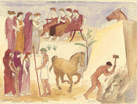
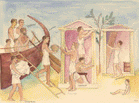
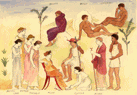
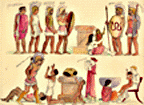
I have attempted to reconstruct the first mural, Troy Taken. I've divided the long composition into a series of panels which may be found on the following pages, accompanied by the text of Pausanius' description and my commentary. My aim in this hypothetical reconstruction is to give a sense of the color and pictorial space of the lost painting--aspects of Greek painting that are only eluded to by vase painting. I've based my illustrations on close reading of Pausanius and on contemporary vase painting, both for mythological themes and the drawing of figures and objects. Although I've attempted to replicate the classical style of Polygnotos' work, I may offer nothing but an interpretation.
Pausanius' Description
Pausanius considered Polygnotos' painting in the Lesche an important part of his chapter on the Sanctuary of Apollo at Delphi, worth describing in detail. He identifies each figure, locates each in the composition, and comments upon the possible sources of Polygnotos' particular narrative arrangement. Pausanius is however more interested in the mythological narrative than the stylistic elements--he mentions little about color or the treatment of the background. Since no wall or panel painting of this scale survives from the Classical period, Pausanius' description must serve to illuminate this lost medium. In the treatment of the figures and narrative contemporary vase painting relates to large scale wall painting, but the medium of vase painting does not have the range of color or scale of field--which encourages a greater definition of pictorial space possible in wall painting.
Polygnotos and Contemporary Vase Painting
A striking feature of Pausanius' description is that the figures are placed on varying levels in the composition, not on a single ground line as is the case in previous vase painting. A few vases painted around the 460s in Athens also dispense with a rigid ground line: the Niobid Painter's calyx-krater in the Louvre, a volute krater of an Amazonomachy at the Metropolitan in NY, and a pelike by the Lykaon Painter in Boston. (Pictures of these and others not available in Perseus may be found in several books listed in my bibliography.) The format of vase painting is well-suited for a single continuous zone of active figures. Two examples of expressive power achieved within narrow compositional restraints are the Keophrades and Brygos Painters' versions of the Sack of Troy. Both make use of a frieze of interlocking figures on a single ground line to describe the height of battle.
Polygnotos depicts the aftermath of the battle rather than its climax. When the ground plane is varied and figures are placed throughout the field, the action is dispersed and less vigorous and dramatic. Many figures are still, standing and sitting in groups. In reconstructing the painting, I have placed figures on various levels, and left only a little indication of the ground, which is meant loosely to suggest pictorial space. I've included rocks and trees which apear also on vases as indications of setting.
I've taken most of my drawings of figures from vases illustrated in John Boardman's Athenian Red Figure Vases: The Classical Period --a resource of many stylistically relevant vases. Polygnotos worked in the 460s, contemporary with several vase painters whose work I have particularily drawn upon. The Achilles, Phiale, Penelope Painters are important in the Classical period, as well as the vase painter Polygnotos, who takes his name from the wall painter, and followed in the steps of the Niobid painter. There is also a group of individual painters called by Beazley the Polygnotos Group. By directly copying some figures from these few painters who worked during this limited time period, I hope to reconstruct a general sense of Polygnotos' painting in the drapery, hairstyles, and other objects in the description in the style of the time.
For color I've taken inspiration from white ground vase painting. Examples of color on white ground are: an Athenian Krater from Vulci at the Vatican, a cup of Apollo and Muse in Boston, and some fragmentary works by the Sotades painter. See Martin Robinson's Greek Art and Greek Painting for these illustrations. More examples of white ground vase painting may be seen in the Perseus browser, including this lekythos. (Although a broad range of color is rare in these vases.) Etruscan tomb painting gives also a helpful impression of what Greek colors would have been like. I have followed the tradition in ancient painting of sex diferentiation by color of skin: women were painted with white skin and men dark.
Pausanius was interested in the mythological narrative of the painting and the identity of the figures, most of whom were named by inscriptions. Pausanius comments on the various sources Polygnotos must have used in constructing the narrative composition, as well as the parts he has invented. Much is from a lost poem by Lescheos but at times the painting follows the Iliad and Odyssey. I have included vases where similar subject comparisons are helpful.