Peleponnesian War
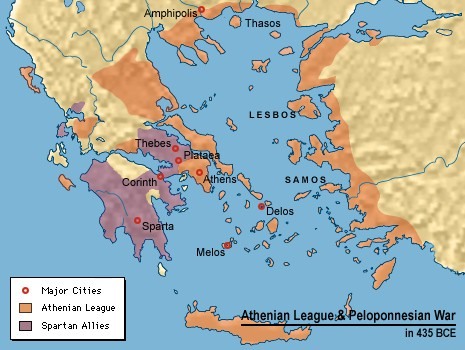
Ancient Greece in 431 BC was not a nation. It was a large collection of rival city-states located on the Greek mainland, on the west coast of Asia Minor, and on the many islands of the Aegean Sea.
Most of the city-states had become allied with one or the other of the leading military powers, Athens and Sparta. Athens was a great naval power, while Sparta relied mainly on its army for superiority. In 431 BC these alliances went to war against each other in a conflict called the Peloponnesian War. The war, which went on for 27 years, is named for the Peloponnesus, the peninsula on which Sparta is located.
The result of the war was the crushing defeat of Athens and the end of its maritime empire. A more long-range result was the weakening of all the city-states. This made them vulnerable to a takeover by Macedonia several decades later. A brilliant account of the war was written by the historian Thucydides as events unfolded. His work still stands as a definitive source of information on the war.
The Athenian Empire and the Spartan Alliance coexisted as long as a balance of power was maintained between them. A truce called the Thirty Years' Treaty had been signed by both powers in 445 BC. Within a decade the truce was breaking down as Athens sought to extend its empire. In 433 Athens allied itself with Corcyra, a colony of Corinth, but Corinth was an ally of Sparta. Incited by Corinth, Sparta accused Athens of aggression and threatened war. Athens, under the leadership of Pericles, refused to back down. War began in the spring of 431, when Thebes, a Spartan ally, attacked Plataea, an ally of Athens.
The war fell into three phases. First came ten years of intermittent fighting, concluded by an uneasy truce in 421. This truce phase, named after the Athenian general Nicias, lasted until 415. The final phase began when Athens launched a massive and ill-fated assault against Sicily. This campaign was so catastrophic for Athens that the city barely recovered militarily. In 411 the democracy at Athens was also temporarily overturned, and the city remained in political turmoil for years. When the democracy was restored, its leaders could not agree on truce terms, and many wanted to continue the war at all costs. Fighting went on for the next six years. Athens rebuilt its fleet, while Sparta and its allies created their own navy. The end for Athens came in 405, when the Spartan navy under Lysander decisively defeated the Athenians in the battle of Aegospotami.
Strategy
As the war began, Sparta and Athens each took advantage of their military strengths. Sparta, with its much larger army, ravaged Attica the territory around Athens while the Athenian navy raided cities on the Peloponnesus. This strategy lasted for two years. Meanwhile Pericles' death in 429 left the democracy prey to hostile factions and reckless leaders who pursued their own advantage. Most of the leaders were warmongers who insisted on vigorous prosecution of the conflict. Chief among these demagogues was Alcibiades, who was as irresponsible as he was brilliant. By 425 Sparta's hopes for victory were bleak, and its leaders were ready to ask for peace. Slowly, however, the fortunes of war changed. Sparta, under its general Brasidas, scored significant victories at Chalcidice (424) and Amphipolis (422). Both were serious losses for Athens. The Athenian leader Nicias persuaded the city to accept Sparta's offer to cease hostilities in 421.
Truce
The six-year truce was used by both sides to win more allies. The peace was doomed because the fighting thus far had settled nothing. On both sides there were men eager to renew the conflict. Alcibiades took the lead in promoting the Sicilian expedition in 415. When he was recalled to Athens to stand trial for religious offenses, he defected to Sparta. Athens was badly defeated at Sicily but survived for a few more years because Sparta did not press its advantage after the Sicilian losses.
By 412 Sparta, with the help of allies, had built its own navy. This was done with aid from Persia, a traditional enemy of the Greek city-states. Sparta's alliance with Persia, however, made the other city-states uneasy, and they became less eager to revolt against Athens. Athens was in trouble politically by this time. An oligarchy (government by a few) overthrew the democracy in 411, and the oligarchs were soon replaced by a more moderate regime. Full democracy was restored in the summer of 410 after a major Athenian naval victory over the Spartans. Alcibiades was recalled by Athens and given supreme command. But in 406 his fleet was lost in the battle of Notium, won by Sparta's Lysander, who was the ablest Spartan commander in the war. Battles continued, mainly at sea, with each side trading losses.
Peace
In 405 Lysander took his navy northward to the Hellespont (now called the Dardanelles) to cut off Athens from its vital grain supply lines to the Euxine (now called the Black) Sea. Lysander made a surprise attack on the Athenian ships at Aegospotami while the crews were dispersed on land. All but nine of the Athenian ships were lost, and several thousand Athenians and their allies were slain. Peace was signed in the spring of 404. Sparta won the war and imposed humiliating terms on Athens. The city walls were to be torn down; the fortifications of its port, the Piraeus, were to be destroyed; and all but 12 warships were to be surrendered. Athens was henceforth to be a Spartan ally and to follow the same foreign policy.