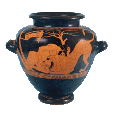
 | L-64-185 Heracles fighting the Nemean Lion. After ruining all his weapons on the lion's impervious hide, Heracles must choke the monster to death. Afterwards he wears its skull as a helmet and its skin for a cloak. H. 33.5; L. 40.0; Dia. 30.0 cm. Photo courtesy Public Information Office, Univ. of Pennsylvania Museum. (132k) |
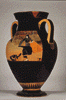 | Attic Black Figure Amphora ca. 530 BC Style between Exekias and the Lysippides Painter Orvieto, Etruria MS 3497 The Attic Black Figure style of vase painting developed in the late 7th century BC from Corinthian painting and reached its fullest development in the period represented by this amphora. The story of Heracles and the Nemean Lion is illustrated on one side, while a Dionysiac scene decorates the other. In the early 5th century, production of Black Figure work began to decline and the new Red Figure style was increasingly evident. H. 56.5; Dia. 38.0 cm. Photo by Maria Daniels for the Perseus Project. (132k) |
 | Silver Tetradrachm ca. 324 BC Alexander the Great, Babylon mint 29-126-469 Head of Alexander-Heracles in a lionskin helmet. The first coins portraying Greeks, whether living or dead, developed only after the death of Alexander the Great in 323 BC His own coin portraits are therefore posthumous; the coins struck for Alexander during his lifetime in which his features are merged with those of his ancestral hero Heracles cannot be counted as true portraits. Dia. 25.0 mm. Photo courtesy Registrar's Office, Univ. of Pennsylvania Museum. (116k) |
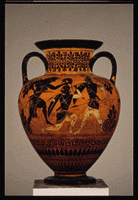 | Attic Black Figure Amphora ca. 530-525 BC In the manner of the Lysippides Painter MS 5467 Both sides portray scenes of mythological battle, which symbolize the Greek preoccupation with struggle as well as their love for detailed battle narrations. Such scenes are a hallmark of Archaic art. Here, Heracles (at the left) fights with two Amazons, a race of female warriors thought to live on the fringes of the civilized world. H. 41.0; Dia. 28.0 cm. Photo by Maria Daniels for the Perseus Project. (132k) |
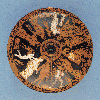 | Attic Red Figure Pyxis ca. 400-390 BC By the Meleager Painter MS 5462 Heracles and Hebe's wedding in the presence of the gods on Mt. Olympus. The lid of the pyxis shows Heracles leading Hebe to his house, while an Eros or Cupid figure carries a marriage torch in front of the wedded couple. Hebe is dressed in a white and gold chiton and himation and wears a wedding veil which another Eros adjusts. A goddess lights the scene with a pair of torches. Athena and Zeus sit enthroned, while Hera leans intimately against Zeus's shoulder. A third Eros reclines against Zeus's throne next to a high-stemmed censer for burning incense. Behind the Eros is a low, footed chest, probably a wedding gift. Two women carry a jewel box for the bride and a vessel containing water for her bridal bath. H. 9.0; Dia. 21.8 cm. Photo courtesy Public Information Office, Univ. of Pennsylvania Museum. (165k) |
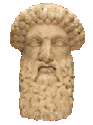 | Herm Head Probable creation of ca. 100 BC after a 5th century BC work. 30-51-1 H. 35.0; W. 23.0; Th. 18.0 cm. Photo courtesy Public Information Office, Univ. of Pennsylvania Museum. |
 | Silver Decadrachm ca. 400-375 BC Syracuse 29-126-41 Racing four-horse chariot with a flying Nike personifying Victory crowning the driver. The space below is filled with captured Punic arms. This spectacular coin may commemorate the victory of Dionysius I over the Carthaginian general Himilcon and the deliverance of Syracuse from its Punic siege in 396 BC The reverse of the coin is signed by Euaenetus, one of the most renowned coin designers of antiquity. Commemorative types became especially popular in the Hellenistic period after Alexander's death in 323 BC Dia. 34.0 mm. Photo courtesy Public Information Office, Univ. of Pennsylvania Museum. (149k) |
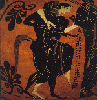 | Attic Black Figure Amphora ca. 525-510 BC On loan, Philadelphia Museum of Art L-64-258 detail Dionysus, holding a grapevine and his drinking horn or rhyton, is flanked on each side by a goat-horned satyr and one of his band of female worshippers called maenads. Photo by Maria Daniels for the Perseus Project. (149k) |
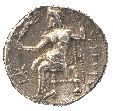 | Silver Tetradrachm ca. 302-301 BC Seleucus I Seleucia-on-Tigris mint 29-126-479, reverse Enthroned Zeus holding a Nike or personification of Victory in his outstretched right hand. The coin type is based, at least in a generalized way, on the Phidian cult statue of Zeus at Olympia, which by the end of the 4th century BC was perhaps the most famous statue in the Greek world. (Coin is shown larger than actual size.) Nothing of these colossal images has survived antiquity intact. Of Phidias's masterpieces all that has been preserved with certainty are a few sculptor's tools, molds and bits of ivory excavated from his workshop at Olympia. Photo courtesy Mediterranean Section, Univ. of Pennsylvania Museum. (132k) |
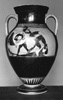 | Attic Black Figure Amphora ca. 540-530 BC By Exekias Orvieto, Italy MS 3442 Scenes from the Aethiopis, a largely lost 7th century BC epic poem. Menelaus fights the Egyptian King Amasis, while Ajax lifts Achilles' body to drag it off the field of battle. The legendary exploits of mortals at the time of the Trojan War provide a rich source of material for artists, especially during the 6th and 5th centuries. Only human protagonists appear here, but the background roles of the gods would have been familiar to most Greeks through their close acquaintance with the epics of Homer and other literary sources. H. 58.3; Dia. 34.0 cm. UM neg. S8-2751. (182k) |
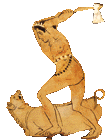 | Campanian Red Figure Bell Krater Late 5th century BC By the Cassandra Painter or his circle MS 5687 detail A somewhat unorthodox hunting scene, perhaps depicting a legendary event in which a young man slays a boar with his ax. Photo courtesy Mediterranean Section, Univ. of Pennsylvania Museum. (116k) |
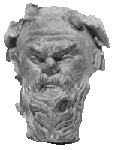 | Terracotta Head of Silenos First half of the 3rd century BC MS 1869h Head of an elderly silenos or satyr. Originally part of a large terracotta figurine depicting one of the plump and intoxicated drinking companions of the god of wine. Normally jovial, here the snub-nosed creature grimaces fiercely. Absent too are the horse ears and beard that normally characterize silens in earlier Greek art. H. 9.2; W. 7.0; Th. 7.0 cm. UM neg. S4-65788. (165k) |
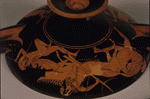 | Attic Red Figure Kylix ca. 480 BC By the Foundry Painter and the potter Euphronios 31-19-2 A centauromachy or battle between two armed Greek warriors and an elderly centaur armed with the limb of a tree. H. 9.7; L. 31.2; Dia. 23.8 cm. Photo by Maria Daniels for the Perseus Project. (66k) |