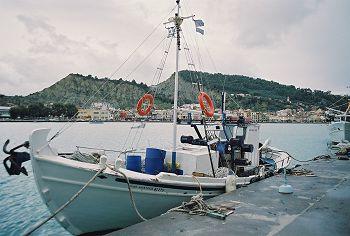
The naval Greek history does not have a concrete point of beginning. Roots are lost in depths of centuries of history of human gender. In a geographic space within 150 km. from the sea, the Greeks from the prehistoric years developed societies as a rule coastal. As most of the interior land is mountainous and difficult to farm, Greeks have to explore the marine resources and love the sea.
Greece is located near the center of the Mediterranean Sea, right at the crossroads of many ancient shipping paths. Automatically, was created the need for the protection and spread of cultures that they developed, with result the progressive constitution of first organized fleet. Argonauts and Trojan War, were the first Pan-Hellenic naval enterprises.
The information about ancient Greek ships is very limited. The problem is that the wood with which these ships are built does not survive long enough in the sea. The lifetime of wooden ships is very limited, therefore it is not surprising that almost none of the ancient Greek ships survived. We know what we know from literature sources such as from Homer describing Odysseus building a ship or from pottery images or from fresco paintings. Here the problem is how much these images (or text) are artistic and how much they represent the reality.
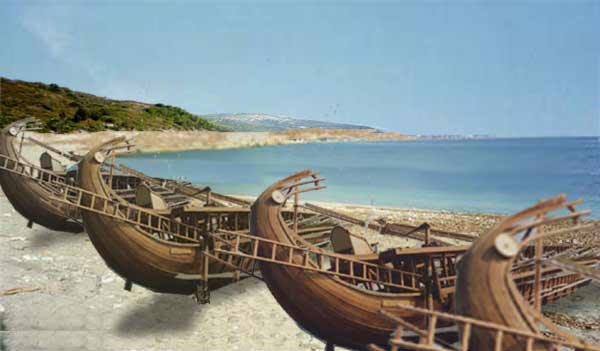
Stone Age (Mesolithic and Neolithic periods 11.000 BP to 3.200 BC)
The Aegean has since prehistoric times been a sea that has united rather than separated the large or small islands. Between these islands, there were narrow sea passages and shallow gulfs, accessible by some primitive sailing means. Navigation in the Aegean, has been testified by the tools made of Melian obsidian which were found in Franchthi Cave in Hermionid (at the eastern coast of the Peloponnese, a distance of 80 nautical miles (approximately 150 kilometers) from Melos! Tools made of Melian obsidian also found on Crete (Knossos) and on Cyprus, substantiate the existence of sea routes in the Aegean from the Early till the Final Neolithic (6800-3200 BC).
On examining the oldest pictorial records of ships from the Near East and Egypt, and from descriptions of navigation methods of the first sailing means as well as the prevailing conditions in the geographical area in question, it can be concluded that the first ships crossing the Aegean were probably made of papyrus and used oars.
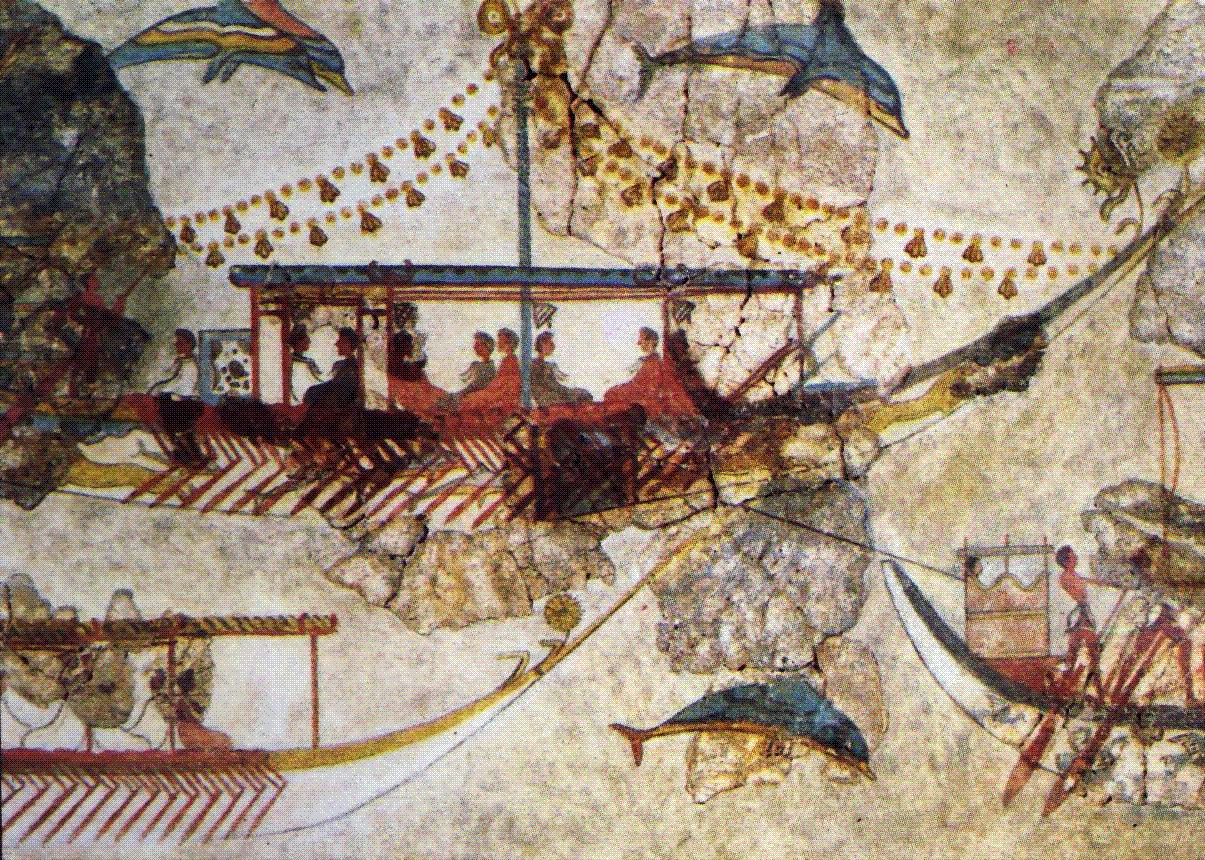
Bronze Age (3.200 - 1.050 BC) - Minoans Traders
During this period agricultural and handicraft products were gathered and distributed to the domestic and foreign markets. The exchange of products with distant countries was served by the perfectly organized shipping and the foundation of commercial stations in significant ports of the Mediterranean. Moreover, it is much likely that Minoans had taken over a part of the international transit trade also, thus transporting along with their own products those of other countries.
Paintings that was found in Acrotiri in Thera (Santorini) show that Minoans used various types of ships.
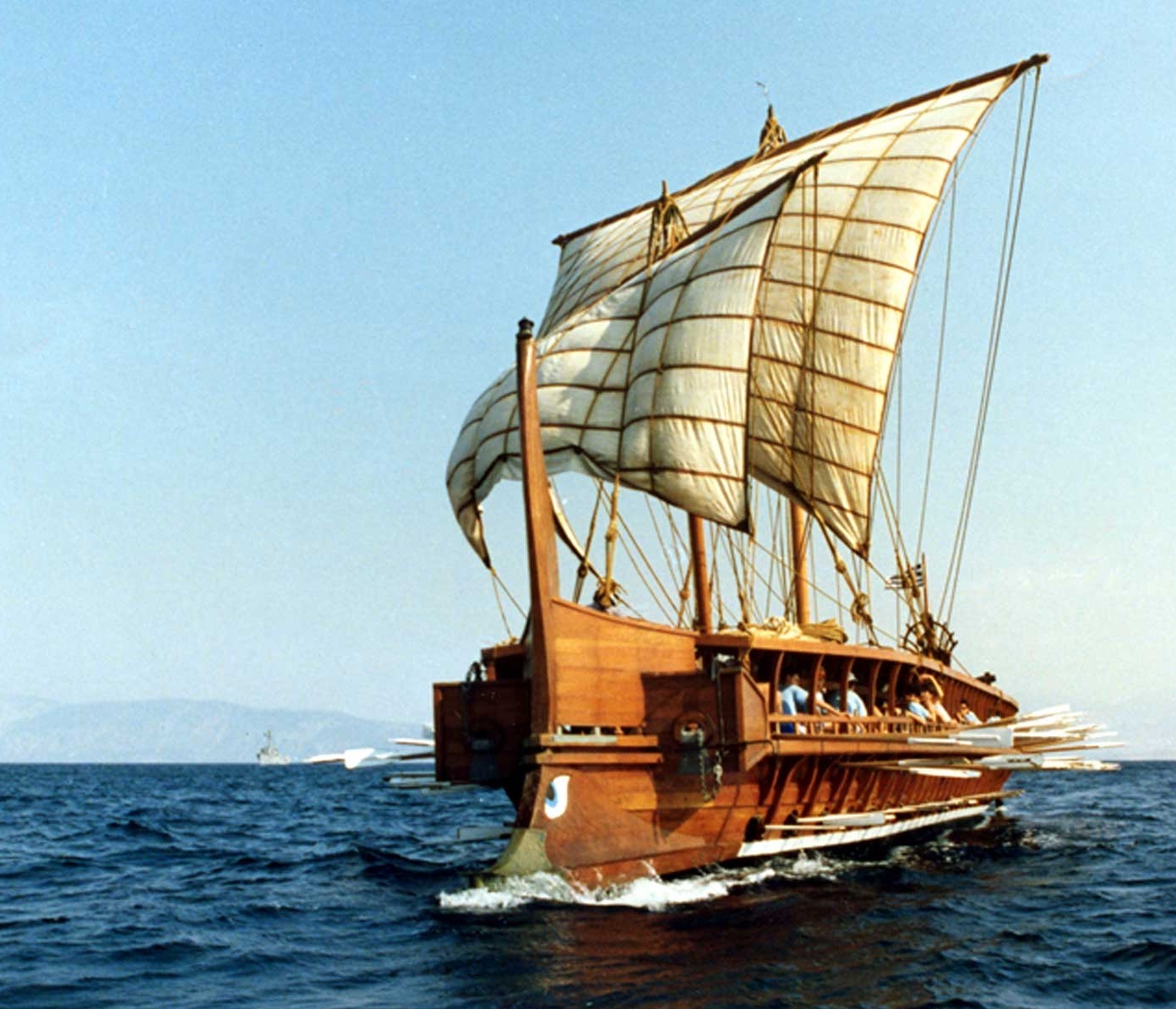
Classical Period (5th century) - Athenian Trireme
In the Classic Years the naval activities were blossoming. Remarkable the effectiveness of Athenian Fleet, with more brilliant example the famous naval battle of Salamis against the Persians.
The main defense weapon of Athenians was Trireme (boat with three lines oars) that destroyed the heavier and cumbersome Persian and Phoenix boats.
During the Hellenistic Period (334 B.C.) Alexander the Great began with the infantry and his cavalry the big Eastern expedition up to the borders of India, in the return he entrusted mainly his fleet, with worthy leader the admiral Nearch. Sailing on the Indian River and the long trip from his estuaries up to the Persian Gulf constituted one of the biggest achievements of the Hellenic Navy. Furthermore, they continued with the exploration of coasts of Arabia and Caspian Sea, while the east Mediterranean becomes Greek lake protected from the boats of Ptolemachon and Selefkidon.
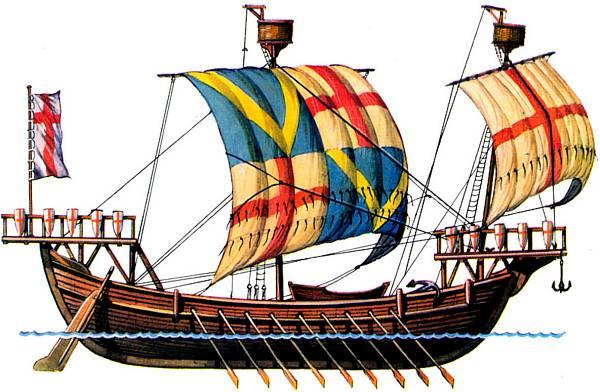
Byzantine Period (324 -1423 AC)
The most important Byzantine naval ship was Dromon , a light and swift boat which came in many different forms and sizes. was two-decked, and could be up to 55 meters long and six metres wide. The ship was manned according to its type and dimensions. Some could carry 100, 200 or even 300 men of whom some were marines who in battle were supported by a number of the rowers.
Dromon had a central tower (xylokastron = wooden castle) near the main mast, from which the marines could use their bow and arrows or throw spears and other projectiles.
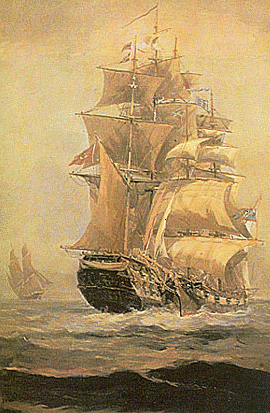
Greek War of Independence - Navarino Battle (1827)
The raid of Byzantium in 1453 from the Ottomans ended a successful period for the Hellenism and sank the Greeks in the dark of slavery. However, the supremacy of Greek slaves in the naval strategy continued to give them precedence, raised their biotic level and likewise the treaty of Kiutsuk Kainardji giving freedom on the Greek seas.
During the 1821 revolution the most important role played the Navy. The Greeks lost the battle enough times in the land, but never in the sea while fearless raiders with their fleet caused heavy losses in the Turkish Navy that tried to intervenes in the Revolution. It is not accidental that the Greeks won their dependence on the sea with a famous naval battle, the naval battle of Navarino.
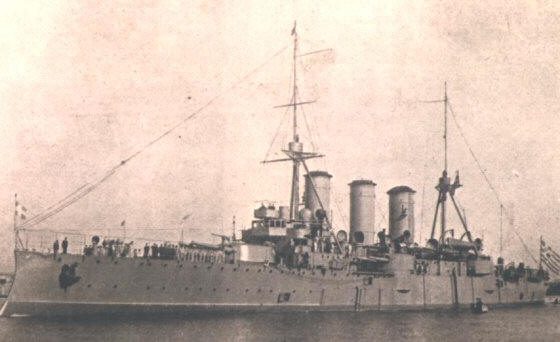
The new Hellenic State (1829 - our days)
After the 400 years slavery and War of Independence the economy of Greece was totally destroyed. Agricultural production was at a very low point, while trade and maritime activities were practically at a standstill. The few boats that have remained after the fights for the independence, constitute the core of a new commercial fleet.
Even if from the beginning of 19th century has made his appearance the steam boat, Greek commercial fleet remains sailing because the lack of necessary capital for the purchase of such ships.
First steam boats are bought from Greeks from abroad, mainly Romania and Trieste, but also from the Greek Government who bought in 1856 three steam ships.
In our days sailing and steam boats of yesterday have given their place in modern giants of big figurative faculty and benefit of comforts for passengers. The Greek flag travels in all seas and Greek ship-owners possess one from the first places in the world shipping.