This information came from Lauren Windham and Tonya Pettigrew's class notes from Dr. Steve Arbury's chronological lecture on Ancient Greek Art and Architecture.
ART FROM THE AEGEAN CIVILIZATIONS
| Cycladic Art | 3000-2000 BC Art found from the island group of the Cyclades |
| Minoan Art | 2000- 1400 BC found on Crete |
| Mycenaean Art | 1500-1100 BC from the Citadel of Mycenae |
| From this point on, approximately 1100-800 BC, was the so-called Dark Age in Greece. After that emerged the well known Greek Classical Period emerged. | |
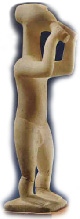
Сycladic Art, 2500 BC
Distinct features of the art:
- Composed of Idols
small, simple sculptures used for funerary purposes. Most of these were found in the horizontal position.
- Most of these figures are female and range from 1 to 5 ft tall.
- Only facial features were a protruding nose; some have been found with paint remnants on them that suggest they were brightly decorated
- If these figures were men, they were shown playing musical instruments, e.g., harps and flutes.
- fewer male statues were done than female.
- Few ceramics were done during this time.
Minoan Art
Distinct features of the art:
- Knossos- most famous archaeological site on Crete and has the best remains.
- Heyday of the civilization -1750-1450 BC
- 2 periods of palace building
- first palace was destroyed by earthquake or some type of natural disaster
- rebuilt
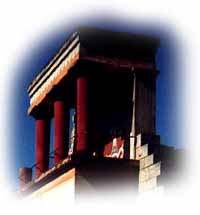
- Palace of Knossos was the hub of Cretan society
Some writing has been discovered from this time period: Linear A and Linear B. Both were found on clay slabs and date back to Pre-Homeric Greek. Unfortunately, only Linear B has been deciphered. It was translated in 1952.
It was earlier believed the Minoan civilization was destroyed by the earthquake that erupted on the island of Santorini (Thera), but today we know the eruption took place in 1628 BC and the Minoan civilization lasted past the time of the eruption. It is belived that the myth of Atlantis sprung from the events that occurred on Santorini due to the damage created by the eruption. A portion of the island blew off and into the Aegean.
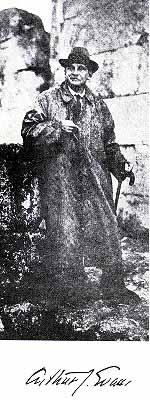
In the year 1900, Sir Arthur Evans, a British Archaeologist, began reconstruction on the Palace of Knossos. Earlier, he had a hunch that under a large hill he would find something special on Crete. He began to dig, and the Palace of Knossos emerged.
From digging at Knossos, he discovered the Minoans were a highly developed civilization with such creature comforts like running water.
An interesting note: Sir Arthur Evans also found the remains of a possible theatre-like structure at Knossos. If it can be proven that actual performances occurred there, it would set the origin of Theater much earlier than Thespis, et al., and the Greeks!!!
The Palace
- 5 stories high, very large for the time period
- was centered around a court yard
- Structure appears maze-like. Possibly gave rise to the minotaur myth. It was believed the minotaur was locked in a labyrinth on Crete by King Minos. The Palace of Knossos resembles a maze and may be the basis for this myth.
- The palace sits on a hill top overlooking the sea, and has no defensive wall
- Inverted, tapered columns
- the palace was built of brick, stone, and rubble
- 3 functions of the grand staircase:
- let in the light
- common use for traveling between floors
- air circulation/ventilation
- Queen's Megaron:
- Dolphin fresoes on wall
- patterned, stylized borders, traces of redecorating by change in patterns
The Knossos Throne room:
- Oldest throne in Europe
- Wall decorations consist of Gryphon frescoes and stylized plants. These decorations flank the stone throne that sits against that wall.
Outside of the palace:
- Storage magazines in ground used for storing perishable foods. It is cooler underground, and this technique could keep food fresher, longer.
The Bull
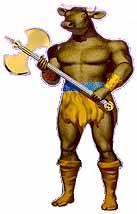
A sacred animal to the Minoans. Some art portrays a bull game where both men and women flip over the bull in a death defying game
The primary Minoan religious symbols were the double-headed ax (Greek word "Labrys") and the bull. Unfortunately, not much is known about Minoan religion.
How the minoans portrayed people in art:
- Men were painted in a darker flesh tone than women.
- All had a perky nose
- Small wasp waist
- Elongated body
On the nearby island of Santorini... The first known European landscape was done. The fresco showed rolling hills and plants. This piece of art predates the Roman landscapes by 1,500 years!
The importance of pottery
Even if pottery is in shards, it is one of the most important tools in art and history in general. Pottery is virtually indestructable. Once it has been fired it can crack and break, but the shards are never going to erode or disintegrate. These little pieces of history can be the key to an entire archaeological dig, and the insight into the way a people lived.

Specific examples of early pottery:
- Stylized Bird Pottery (pitcher)
- Octopus Jar- 1600 BC The creator of this vessel emphasized the 3D qualities by placing the octopus in a naturalistic flowing form that appears to take the shape of the jar and gives the appearance of a fish bowl. The jar is accentuated by the octopus filling out every inch of its form, and thus a beautiful harmony of form and function is created. This jar is yet another example of marine life portrayed in Minoan art.
- Minoan mixing bowl with ceramic flowers
- Snake Goddess
- Harvester Vase
- (we also saw an example of a rhyton, a vessel used for ceremonial purposes: bulls' heads, lions' heads)
The Mycenaeans
1450 BC - The Minoan civilization started declining rapidly. Mycenaean begins to take over. Their height overlaps the end of the Minoan civilization for about 200 years. We'll be travelling to Mycenae where we'll see the ruins of the citadel. The walls around their city were so thick and amazing that centuries later during the height of Athens, scholars thought only Cyclopses were strong enough to have created them. These walls, then, are also called cyclopean walls.
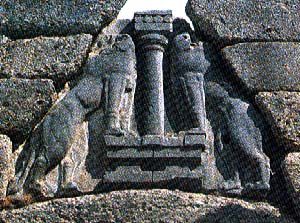
The Lion Gate: very important feature of the Mycenaean citadel. Showed the power and prestige of the city, and modern coats of arms also feature regal beasts flanking a central design like the gate. Why did they put the lion statue there? Well, the way the walls were designed, they needed something to lessen the weight on the lintel. Using a triangular shape with designs was a lighter alternative.
The Megaron design is also very important to note because many art historians believe it evolved into the temple format used by the later Greeks at Athens and elsewhere.
The "Death Mask of Agamemnon" was also found at this Mycenaean citadel.
Greek Art Periods:
- Geometric Period: 900-700 BC
- Orientalizing Phase: 700-600 BC
- Asian and Persian influences
- Dragon motifs
- Other interesting creatures emerge
- Archaic Period: 600-480 BC
- Classical Period: 480 (Battle of Salamis) - 400 BC
- Late Classical: 400 - 323 BC
- Hellenistic Period: 323 (Alexander's death) - 30 BC (Cleopatra's death)
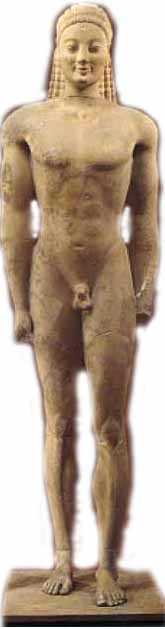
Examples of Archaic art:
- Black Figure style vases
- Kouros (pl. kouroi) figures (male)
- Kore (pl. korai) figures (female)
- style and stance of the Kouroi is taken from the Egyptian style used to depict pharaohs: the arms and legs are close in to the body because the Egyptians were interested in making statues that lasted. The Greek versions are not as rigid because they were trying to express humanity.
- the men were nude
- the women were clothed and often had one extended arm
- both the men and women would have been painted to show more realism
- the eyes were large, bulging, and trancelike
- the mouth was shaped into a quirky half-smirk
- the hair was also stylized and not realistic
- the ears were placed too high on the head
- the shins came to a point in the front
- the pelvic region was highly defined
- Early Greek art is stylized. The Greeks were trying new things to portray a greater naturalism and human perfection.
The Treasury of Atreus: When first found by archaeologists, they believed that it must have been a treasury because of the style. Actually, it was a tomb. It is a corbelled stone dome -- it is not a true dome nor a true arch but a combination offering stability. (The dome was finally perfected when the Romans built the Pantheon.) The Treasury of Atreus is a beehive tomb and most of it is underground.
5 Common Types of Vases:
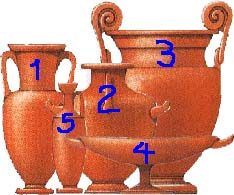
For pictures and more information, turn to page 61 in the Eyewitness Travel Guide to Greece book we bought for class.
- Amphora
- Hydria
- Krater
- Kylix
- Lekythos
3 Orders of Greek Architecture:
A great introduction to Greek Architecture can be found at this site.
- Doric (the oldest)
- plain captial
- columns had no base
- three bar triglyph and metope frieze
- flutes on columns come to a point
- Ionic
- derived from the Ionians on the west coast of Turkey
- scrolled capital
- column has a base
- flutes on columns are flat edged
- continuous frieze
- Corinthian
- similar to Ionic
- fancy and ornate capital consisting of acanthus leaf decorations
FYI: Pericles was the man behind rebuilding Athens after the Persian destruction. The two architects of the Parthenon were Iktinos and Kallicrates. The main sculptor was Phidias.
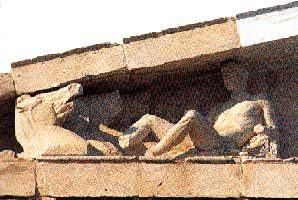
Pediments on Temples, etc.
A pediment is the triangular shaped area that rests on top of the architecture. Once again, for a further explanation of what a pediment is, turn to page 59 in our Greece book.
Pediments evolved a great deal from their archaic forms. Early pediments placed human figures in various scales side-by-side throughout the triangular area. By the Classical Period, pediment design had evolved and humans were depicted in the same scale throughout the entire triangle and in a uniform narrative. People were placed in different poses and positions in order to fill the small and large spaces in the pediment.
There are three types of battles portrayed on Greek pediments:
- The Gods vs. The Titans
- The Lapiths vs. The Centaurs
- The Greeks vs. The Amazons
All of these scenes alluded to the battles between the Greeks and the Persians.
The Classical Period
The Classical Period is marked by the finding of the Kritios Boy which shows the true human form emerging in Greek art.
The main way the transition was made between Archaic and Classical art is the use of the contrapposto stance. This way of standing is truer to life and actually shows the natural shift in people's hips when standing. Sculptures overall begin to reflect real humans: no pointy shins, no eyes bugging out, etc. But, the faces of Classical sculptures did NOT show emotion because human intellect is above the passions. Only the statues of animals showed emotion.
The Acropolis
"Acropolis" means "city on high." Every city-state in Ancient Greece had an Acropolis. The Athenian Acropolis is famous because so many of the old buildings survived.
The most famous remaining building is the Parthenon, whose name was chosen to reflect the virgin birth of Athena.
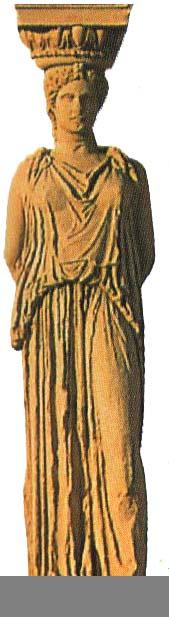
Also on the Acropolis is the Erechtheum. It is a temple that is famous for its caryatids -- columns shaped like women.
The Temple of Athena Nike is also on the Acropolis. It is a smaller temple that was dedicated to Athena as the winged goddess of victory.
The Hellenistic Age
By this time, Alexander the Great had conquered the entire known world. His death, at age 33, marks the beginning of the Hellenistic Age.
There were many changes in Greek art because Alexander had unified so many different cultures that there were incredible influences on the artisans on the Greek mainland. Sculptures and other artworks began to show more and more emotion.
A prime example of that is Laocoön, an amazing work of art created around 50 BC. Laocoön was the Trojan priest who warned Troy not to accept the Horse. The statue portrays Laocoön and his two young sons being attacked by snakes. The work is very powerful, but it does have its faults. For example, Laocoön's face shows an old man, but his body is that of a 25-year-old! Even though the Greeks had come a long way in portraying emotion, they still were styalized and poetic in their art; the emotions displayed are not 100% true to life.
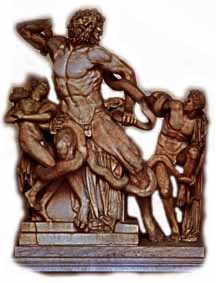
The art of the time showed drama, emotion, and people of all ages. Perfection was no longer the goal -- real life was.
It's hard to believe that Greek art was transformed from simple, archaic human forms into perfect replications of the human body in only 300 years, an evolutionary feat unsurpassed in the world.