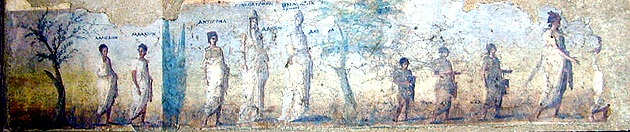
As seen in the literature of ancient Greece, tombs and rituals of the wealthy were extravagant. Gold and jewels were essential grave offerings of respectable and honored tombs, perhaps used as a way to display wealth and status. It seems the wealthier you were the more elaborate your final resting place. The ancient Greeks had distinct methods of burial, and it was often believed if you were not provided a proper burial along with the appropriate rituals, you were destined to suffer between worlds until your rites of passage into the underworld were completed. In this essay we will see how exactly a tomb of Greece looked, the rituals followed at the time of death and also what was believed to happen if these elements were not fulfilled. Examining the tombs and rituals from the archaic period through classical Greece shows the continuity of the traditions throughout the years.
While early aristocratic Greeks built pit-like single graves in the ground or out of rock, the archaic period (600-479 BC) marks the time when tombs became more sophisticated. Now we see multiple graves in underground chambers, raised mounds, or masonry-built tombs. Archaeologists have found tombs such as these at Sindos adorned in riches of gold and jewelry (Burnstein et al. 372). The findings at the archaic cemetery are also linked to the Hellenistic period, during which the novels were written. While the sizes of the tombs of this period are larger, decorations of gold are still found throughout the tombs of the wealthy. Evidence of this extravagance is seen in a passage from Chareas and Callirhoe, “Callirhoe, as she lay there dressed in her bridal clothes, on a bier decorated with gold…” (Chariton 28).
The possessions and grave goods placed with the body did not change much; but the amounts of treasures did. The tombs of early Mycenaeans from about 1600 to 1400 BC held bronze weapons such as swords, daggers, and knives and also pottery made locally and small amounts of gold and jewelry (Burnstein et al. 21). As the years went by the grave gifts became more beautiful and plentiful. A later Mycenaean cemetery held an arsenal of weapons, and gold, silver, bronze, ivory, and alabaster gifts imported from places like Crete, Cyprus, Egypt and Syria, just among a few. This shows how much wealthier the ruling class of Greece had become (Burnstein et al. 22). In Sparta, this wealth became evident around the 9th and 8th centuries BC. Before, one could hardly see a difference between the social classes (Burnstein et al. 51). Now the wealthy Greeks chose to conduct heroic-style burials in order to connect with their ancestry. Their funerals closely resemble the funeral of heroes such as Patroclus in the Iliad. The corpse was cremated and placed in a bronze urn inside a tomb that held weapons and sometimes the remains of sacrificed horses. Vases depicting heroic events reveal how the wealthy claimed descent from the heroes (Burnstein et al. 80).
While tomb designs and grave gifts may have evolved and changed over the years, the Greeks firmly believed in a set of burial rituals. The death of Anthia in An Ephesian Tale provides evidence for these customs. “He laid her out in all her finery and surrounded her with a great quantity of gold…And there he laid her in a vault, after slaughtering a great number of victims and burning a great deal of clothing and other finery.” The family then carried out the accustomed rites (Xenophon 151). In Classical Greece the burial rituals actually consisted of three parts. First there is a prothesis, or laying out of the body. The women wash, anoint, dress, crown, cover the body and adorn it with flowers. The mouth and eyes are shut to prevent the psyche (phantom or soul) from leaving the body and the corpse is dressed in a long-ankle length garment. The body is presented so it can be viewed for two days. At the viewings, the mourners dress in black in honor of the deceased and the women stand at the head of the couch to grieve and sing while the men would stand with their palms out to the gods. When it came time for the burial, before the dawn of the third day, the body was taken to the tomb by cart. The men would lead the procession and the women would follow. At the internment the corpse or ashes would be placed in the tomb along with the grave goods of pottery, jewels, vases, or other personal property.
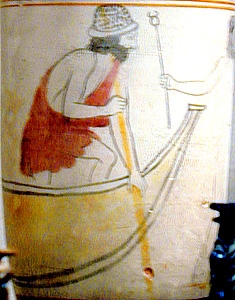
White-ground lekythoi were used for funeral rites and as a gift to the deceased between 470 and 400 BC. These vases were covered with a white slip after being fired. Figures on the vase were outlined in red or black matte. The clothing of the figures pictured was colored in purple, brown, red yellow, rose, vermilion, and sky blue. Along with these gifts, offerings of fruit were made and the mourners would sing and dance. The women would leave the site first to prepare for the perideiprion or funeral party that would follow.
Homeric belief shows that the Greeks saw death as a time when the psyche left the body to enter Hades. This psyche could be seen, but was untouchable. Beginning in Classical times there came to be the concepts of punishment after death or a state of blessedness. The soul responsible for a person’s personality and moral decisions received the eternal punishment or bliss for the choices of the human form. The burial rituals perhaps spawned from this belief that the soul must be guided into the afterlife. If the body was not given a proper burial according to Greek ritual, the soul would remain trapped between the worlds of the living and the underworld.
Demanding proper burial was one of the major reasons why ghosts would show themselves to the people of ancient Greece. Erwin Rohde, the author of Psyche: The Cult of Souls and Belief in Immortality Among the Greeks, states, “The first duty that the survivors owe to their dead is to bury the body in the customary manner…Religious requirements, however, go beyond the law” (Felton 10). While most Greeks were skeptical of the belief in ghosts, there were a few who believed these suffering beings existed. Few accounts of haunting are found in Greek literature, although stories by Plautus, Pliny, and Lucian have been recovered indicating an interest in the afterlife (Felton xii).
Apuleius also provides an example of haunting by a dead spirit through dreams. In The Golden Ass, a baker is murdered, ironically, by a ghost that his wife summoned to kill him in retaliation for his request for divorce. The man is given a proper burial, yet his spirit visits his daughter through a dream to tell her what brought upon his death. “The pitiable form of her father had obtruded upon her sleep with his neck still haltered; and the dead man had disclosed to her the wicked work of her stepmother… and told her how he himself had been haunted by a spirit off the earth” (Apuleius 203). Desecrating the tombs themselves could also lead to being tormented by a spirit. Theophrastus, a 4th century author describes in “Characters” the belief that a superstitious man, “will not tread upon tombstone, for fear that association with the dead will pollute him.” One would not enter a house where a corpse laid awaiting burial either (Felton 5).
These beliefs in spirits led to great yearly festivals in Greece and Rome. The feast of Anthesteria occurred sometime in February and March in Athens. The society believed the ghosts would not leave until they were chased out. On these days everything stopped; the businesses were closed along with the temples. The doors of their houses were covered with pitch and hawthorn leaves and each family member made an offering to the dead. A meal of cooked grain was also offered to Hermes. At sunset of the last day, the master of the house would say, “Away, Spirits; Anthesteria is over” (Felton 12).
All of these rituals and beliefs of ancient Greece certainly point to the fact that Greeks were fascinated by the thought of the afterlife. What they wanted most for the dead was for their spirits to survive and be comfortable in their eternity, as seen in the grave gifts of jewels and personal property. Death was also a time for the family to show off their wealth; however, if the rituals were not followed to exactness the family might suffer the haunting of their loved one.