Art of Ancient Greece and Rome at Getty

Please note: Most of the J. Paul Getty Museum's antiquities collection has been moved to the Getty Villa in Malibu. A portion of the antiquities collection was on view in the Getty Center in the Classical Connections gallery through November 9, 2008.
Classical Connections explores the influence of ancient art on the art of later centuries.

Many of our ideas about art come from antiquity. Portraiture and narrative painting had their origins in the ancient Mediterranean. So did bronze casting, gem cutting, and glass blowing. Even the word museum comes from the Greek mouseion, a place dedicated to the Muses, the goddesses of the arts.

Portraits

The ancient Greeks and Romans honored individuals through portraiture. Roman artists especially are renowned for rendering their subjects' true physical characteristics, and they skillfully used costume, jewelry, and gesture to indicate a person's social or political status.
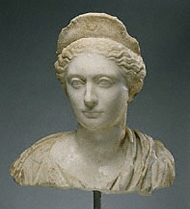
Above is a portrait of Vibia Sabina, the wife of Roman Emperor Hadrian (ruled A.D. 117–138). Hadrian declared Sabina a goddess after her death, and the diadem in her hair shows her changed status from mortal to goddess.

The practice of creating a portrait to honor an individual carries on to the present day. So do many of the methods used to indicate social status.

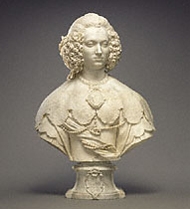
This 17th-century bust of an Italian noblewoman shows her wearing an elaborate hairstyle as well as costly jewelry and dress. Her family coat of arms is carved on the stand that supports the bust.

Interior Decor
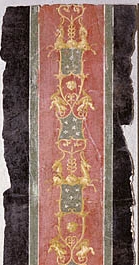
The Greeks and Romans employed fresco, a technique of applying pigment to wet plaster for architectural decoration. They decorated rooms with fantastic designs, floral patterns, monstrous figures, and landscapes.

This fresco fragment is one of many that were preserved in the volcanic debris from the eruption of Mount Vesuvius outside Pompeii in A.D. 79. These paintings became known as "grotesques" because they were found underground, in "grottoes." Renaissance artists copied the designs and patterns of these grotesques to embellish their works of art.

By the 18th century, interest in these ancient designs led to the Neoclassical style, which incorporated grotesques into architectural decoration.

This elaborate paneled room is decorated with classical motifs such as columns, Greek vases, and mythological creatures.

The Classical Nude
This Roman statue of Venus, the goddess of love (below left), is a copy of a lost Greek original made about 350 B.C. Venus's proportions represent the classical ideal of the female figure.

Painters and sculptors of later centuries were greatly influenced by the classical ideal. This was especially true when many ancient sculptures were rediscovered in the 16th, 17th, and 18th centuries.

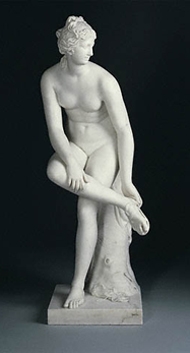
The 18th-century statue of Venus adjusting her sandal (above right) was inspired by the classical ideal. Like the ancient sculptors, Joseph Nollekens chose to depict Venus nude to emphasize her beauty and sexual allure.


Glassblowing

Glassmaking had been practiced for more than two thousand years before artists discovered that it could be inflated at the end of a hollow tube, or free-blown, sometime in the first century B.C. Ancient glassmakers inflated glass vessels in a variety of shapes, colors, and sizes. This vessel was made using a mold decorated with raised knobs that look like lotus buds.
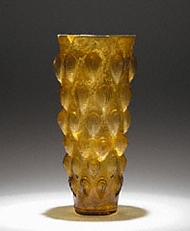
The Romans also made glass that imitated the look of natural stone, for glass was less expensive than semiprecious stone.

Later glassmakers still use glass-forming techniques developed in antiquity. This knobbed Warzenglas, or "wart glass," is a 17th-century example of mold-formed glass.

Today, free-blown glass is more common than mold-blown glass.

Gems
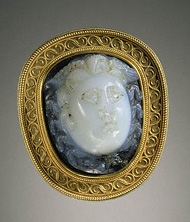
Greeks and Romans used engraved gemstones as personal insignia to mark documents, the way we use signatures today.

Mythological figures were fashionable subjects for engraved gems. The head of the monster Medusa was particularly popular because her snaky hair fit well into an oval format. This gem of Medusa is a cameo, a type of gem carved in relief from two-colored layered stone.

Carved gems continued to be used as personal devices over the centuries. Carvers also copied ancient gems or made their own interpretations of mythological subjects.

Turn-of-the-century sculptor Vincenzo Gemito copied the head of the Medusa from an ancient cameo known as the Tazza Farnese to decorate this large silver plate.

Wreaths
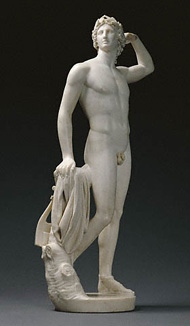
Floral wreaths were awarded as prizes for winning athletic competitions in ancient Greece. Wreaths were associated with special events, and certain plants used to make wreaths were associated with specific gods. Elaborate gold wreaths were worn on ceremonial occasions, and many have been found in tombs.

This 18th-century sculpture by Antonio Canova shows Apollo crowning himself with a laurel wreath. Our term poet laureate comes from Apollo's laurel wreath, because Apollo was the god of poets and writers. Artists, writers, and rulers were also frequently shown in European art wearing or holding wreaths.

The installation is located at the Getty Center, Museum, North Pavilion.

You Might Also Like:

The New Testament

Included here are articles that deal with aspects of specific New Testament Books or passages, but does not include Lectionary Commentary articles. For more general articles on the New Testament, see Bible Topics, Issues in Biblical Interpretation, Biblical Theology, The Bible in the Church, and Hi...
Read More

The Old Testament

Included here are articles that deal with aspects of specific Old Testament Books or passages, but this does not include Lectionary Commentary articles. For more general articles on the Old Testament, see Bible Topics, Issues in Biblical Interpretation, Biblical Theology, The Bible in the Church, a...
Read More

Gospels

DefinitionLiterary StyleSynoptic GospelsSynoptic ProblemThe ProblemProposed SolutionsTheory of Mutual DependenceTheory of Documentary HypothesisTheory of Oral TraditionEclectic ViewWhy SimilaritiesWhy Diferences?Definition The Term Gospel comes from an old Anglo-Saxon word godespel meaning God's tid...
Read More

Timeline

37 B.C.–4 B.C. - The reign of Herod I, a Roman client king of Israel27 B.C.-14 A.D. - The reign of Caesar Augustus, the first emperor of the Roman Empirec. 6 B.C. - The birth of Jesus26-36 A.D. - Pontius Pilate the Prefect of the Roman Empire's Judaea Provincec. 30-33 - The death and resurrection o...
Read More

Miracles

Description The term miracle is a general term used to describe extraordinary workings of God in the world during certain times of man's history. However there are several terms used in Greek and Hebrew to describe what is commonly called miracle. Miracles of Jesus Miracles of Elisha Marvellous Work...
Read More

Fonts for Biblical Studies

Free Unicode fonts and keyboards Unicode fonts are now becoming standard, and they are easy to use with the free Tyndale Unicode Font Kit. Almost all word processors now support unicode - with the notable exceptions of Word Perfect on the PC and Word on the Mac before Word 2004. If you use Windows 9...
Read More

Korean Fonts

Mac Korean Mac Korean is a bit-mapped suitcase that contains the fonts named Inchon, KSL, Pusan and Seoul. With these fonts you can write in Korean without the Korean Language Kit or HanTalk. [Thanks to S. Todd Stubbs and Sol Yang Hwan of BYU for the instructions included with these fonts.] Downloa...
Read More

Hebrew Fonts

BST Hebrew (16 KB; ttf).David New Hebrew (14 KB; ttf).Dor (46 KB; ttf).ElroNet (Monospace and Proportional) (30 KB; ttf).Gideon-Medium (19 KB; ttf).Hadasah (19 KB; ttf).Hebrew (38 KB; ttf).Hebrew Bold, Italic, Bold Italic (61 KB; ttf).Hebrew Parse (26 KB; ttf).Hebrew Regular (36 KB; ttf, afm).Hebrew...
Read More

The Copper Scroll (3Q15)

Column 1 In the ruins which are in the Valley of Achor, under the steps which go eastward, forty rod-cubits: a strongbox of silver and its vessels - a weight of seventeen talents. KEN in the sepulchre of Ben Rabbah the Third: 100 ingots of gold. In the big cistern in the court of the peristyle, in a...
Read More

Texts

The Book of Secrets 1Q27, 4Q299-301 4Q301 F1 (...) I shall speak out freely, and I shall express my various sayings among you (...) (.. those who would understand parables and riddles, and those who would penetrate the origins of knowledge, along with those who hold fast to the wonderful mysteries ....
Read More

A Baptismal Liturgy (4Q414)

The present work was evidently intended to govern a ritual of baptism or ablutions. A sectarian text by virtue of its mention of the Yachad, this liturgy may have operated during the ritual washings that are discussed in the Charter (see text 5, 3:4-9; 4:21; 5:13b-14). The Liturgy's distinctive form...
Read More

Tongues of Fire (1Q29, 4Q376)

1Q29 F.1 (...) (...) the stone, just as the LORD commanded ....) and your Urim. And it (the cloud?) shall come forth with him, with the tongues of fire. The left-hand stone which is on its left side shall be uncovered before the whole congregation until the priest finishes speaking and after the clo...
Read More

The Coming of Melchizedek (11Q13)

Col.2 (...) And concerning what Scripture says, "In this year of Jubilee you shall return, everyone f you, to your property" (Lev. 25;13) And what is also written; "And this is the manner of the remission; every creditor shall remit the claim that is held against a neighbor, not exacting it of a nei...
Read More

The Thanksgiving Psalms

Psalm 4. I thank you, O Lord,for your eye is awake and watches over my soul.You rescue me from the jealousy of liars,from the congregation of those who seek the smooth way.But you save the soul of the poorwhom they planned to destroyby spilling the blood of your servant. I walked because of you - bu...
Read More

The Parable of the Bountiful Tree (4Q302a)

F.1 Col.2 Please consider this, you who are wise: If a man has a fine tree, which grows high, all the way to heaven (...) (...) of the soil, and it produces succulent fruit every year with the autumn rains and the spring rains, (...) and in thirst, will he not (...) and guard it (...) to multiply th...
Read More

Map of Ancient Jerusalem

After 1380 B.C.Jebus, the original name of ancient Jerusalem, is populated by the Jebusites (a Canaanite tribe). It is a city built on seven hills. A partial siege carried out by the tribe of Judah against the city (Judges 1:8) takes place a short time after the death of Joshua. 1010David begins his...
Read More