Researchers announced their discovery of the shipwrecked remains of an ancient trading vessel over 2,300 years old that sank in the Black Sea off the coast of present-day Bulgaria.
The vessel dates to the 5th to 3rd century B.C., an era known to scholars as the classical period of ancient Greece—the time of Plato when Athens reached the height of power and Zeus was believed to rule the celestial firmament.
The shipwreck is the oldest ever found in the Black Sea. It joins a relatively small handful of other known shipwrecks of the Greek period.
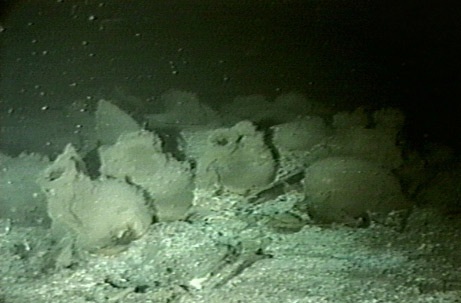
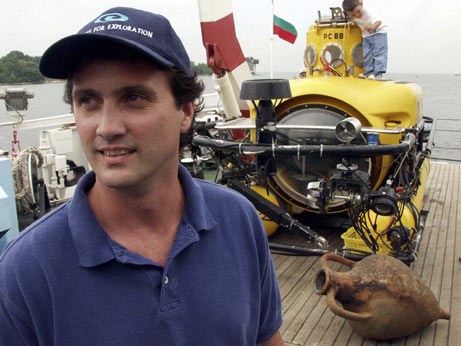
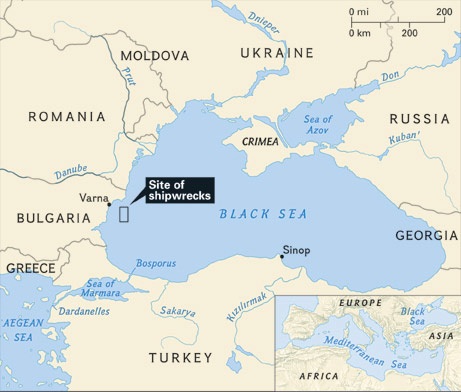
Members of a joint U.S.-Bulgarian research expedition discovered the wreck on August 1, 2002 in 275 feet (84 meters) of water off the eastern coast of Bulgaria. Using a three-person submersible vehicle launched from the 180-foot (55-meter) Bulgarian research ship Akademik, the team dove on a target previously identified by sonar on the last day of a 14-day expedition.
"The first thing [the crew] saw was this pile of amphora. There were probably 20 to 30 jars that were exposed on the surface layer…I knew right away that it was probably ancient," said Dwight Coleman, a marine geologist at the Institute for Exploration in Mystic, Connecticut. Coleman served as chief scientist of the expedition together with Petko Dimitrov of the Bulgaria Academy of Science's Institute for Oceanology, in Varna.
The expedition was the latest in a series of expeditions to the Black Sea initiated by National Geographic Society explorer-in-residence and Institute for Exploration president Robert Ballard, the oceanographer and undersea explorer famous for his discovery of the Titanic and other historic shipwrecks. Since 1997, Ballard has worked with archaeologist Frederik Hiebert at the University of Pennsylvania's Museum of Archaeology and Anthropology in Philadelphia to investigate the ancient cultures and maritime trade routes of the Black Sea. Ballard and Hiebert joined Coleman in making today's announcement.
Amphora Yields Clues, Raises Questions
Researchers said they were most intrigued by the contents of a single, large amphora that was the sole artifact retrieved from the underwater site.
The amphora, a type of two-handled clay jar used by Greek and Roman merchants, is unusually large and measures nearly three feet (one meter) tall by 1.5 feet (0.5 meter) wide—roughly half the size of a 55-gallon (208-liter) oil drum.
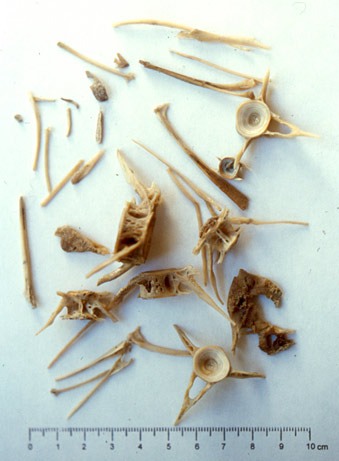
Recent analysis of sediment gathered from inside the amphora revealed that it contained bones of a large freshwater catfish species, several olive pits, and resin. Such seemingly small clues have already answered questions about the ship's cargo and possible origin for researchers, while raising others.
Cut marks visible on the fish bones, together with other physical clues and references from classical literature, lead researchers to believe the amphora carried fish steaks—catfish that was butchered into six- to eight-centimeter (two- to three-inch) chunks and perhaps salted and dried for preservation during shipping.
Such everyday fare would have been consumed by soldiers and the masses.
"The supposition is that generally these kinds of fish were being fed to the Greek army," said Ballard. "It probably was a big supply boat full of butchered fish that was being brought from the fish-rich regions of the Black Sea and their associated lakes back to Greece," he said.
Radiocarbon analysis of fish bone samples taken from the amphora conducted at the Woods Hole Oceanographic Institution in Woods Hole, Massachusetts, indicated that the bones were between 2,490 and 2,280 years old. The analysis also confirmed the age of the shipwreck. (Wood samples were also gathered at the site of the shipwreck. However, radiocarbon analysis indicated that the wood was modern, most likely trash that drifted onto the site.)
Questions remain about the olive pits and resin also found inside the amphora, however, and whether or not the amphora was reused to ship various trade goods. Amphorae most often carried wine and olive oil. Resin was used to coat the vessels' interiors to prevent leakage.
"The key was that inside this particular amphora there were olive pits. So the question [is], was there olive oil? Or was it just…residual from a previous shipment?" Ballard said.
Scientific analysis of a five to ten gram sherd from the amphora could easily answer that question, Hiebert said. He noted, however, that the team was loath to damage an intact amphora. The team plans to obtain a sherd when it returns to the wreck site later this summer. (Analysis of the lipid residues trapped in the ceramic matrix of amphora fragments may reveal any past contents of the vessel such as olive oil.)
A Trading Vessel Bound for Greece?
Despite the already-completed radiocarbon analysis, Hiebert noted that the shape and size of the amphora from the wreck provides more precise data on the ship's age and origin.
While his investigation is still in its most preliminary stages, Hiebert said the recovered amphora resembled those manufactured in a famous Greek seaport found on the southern coast of the Black Sea in the present-day city of Sinop, Turkey.
"It looked like a type of amphora that would be manufactured at the site in Sinop, Turkey. However, we were amazed to find that so far away from Sinop itself," he said.
Hiebert postulates that the ship may have begun its journey on the south coast of the Black Sea, sailed north across the sea following prevailing currents to the Crimean peninsula, where it loaded its amphora with freshwater catfish, then sailed west along the northern coast of the Black Sea bound for Greece.
"This allows us to construct an idea of what Black Sea trade would have been like in the 5th to 4th century B.C.," said Hiebert.
"We find many similarities between the southern coast of the Black Sea and the northern coast of the Black Sea. Now we're finding those same similarities with the western coast of the Black Sea," said Hiebert.
Hiebert indicated that a growing body of archaeological research in the region is leading scholars to revise their understanding of the Black Sea as a central—rather than peripheral—region of maritime culture.
"This is changing our textbooks because here we have a whole culture area that we have to consider. For [those of] us in archaeology and ancient history, this is very exciting," he said.
The researchers said they are anxious to return to wreck later this summer to map and excavate the site and gather more amphora samples to further test their hypothesis.
"From text and archaeology we've been able to learn quite a bit about the Greek presence in the Black Sea and about the interaction of the Greeks with the people who were already living. But it's only been through indirect evidence that we've been able to approach the trade networks that existed," said maritime archaeologist Cheryl Ward, an assistant professor of archaeology at Florida State University in Tallahassee who has also worked closely with Ballard and Hiebert in the Black Sea region. "This shipwreck provides the first opportunity to see [direct evidence of] that early trade in action."
The discovery of the Black Sea shipwreck follows on the heels of another Greek shipwreck from the same period found nearly five years ago in the Aegean Sea off the coast of Tektas Burnu, Turkey. The wreck has been excavated by archaeologist George Bass.
Ward said that taken together, the two wrecks have the potential to tell scholars much about human trade, culture, and industry in the region during that period.
Crossroads of the Ancient World
The Black Sea region has long intrigued undersea explorers and archaeologists.
The region lay at the crossroads of ancient Europe, Asia, and the Middle East. Evidence suggests that the region was a center of maritime trade for millennia, stretching from Roman and Greek times as far back as the Bronze Age.
The Black Sea is also the only sea with a deep-water anoxic layer, oxygen-deprived waters where wood-boring mollusks cannot survive. Because of this, wooden shipwrecks of antiquity can remain in a high state of preservation for thousands of years.
The 70-year reign of the Soviet-era Iron Curtain during most of the 20th century prevented many Western explorers and archaeologists from conducting research in much of the Black Sea.
"It has only been since the fall of the Soviet Union and the opening of the Black Sea as an economic unit as we see it today that we're able to actually go in and study [the region] as it actually was in the ancient world—a sort of maritime province itself," said Hiebert.
"We're just beginning our research," Hiebert said. "It's only time before an older shipwreck is found."