Before 800BC there was no dominant ship type used in the navies of the Aegean Sea. Most ships were little more than long boats of a primitive design. In war they were mainly used to transport troops and naval battles were boarding actions.
In 800BC the ram was invented and this changed naval battles to a contest of speed and maneuver. At first this led to the development of the Penteconter (meaning 50-oared), a sleek ram-armed and fast war galley power by fifty oars, with twenty-five to a side and manned by fifty oarsmen. A large Penteconter could range up to 37-38 meters, the beam would be four meters to allow room for the rowers to work the oars. These ships would have a top speed of 9-10 knots. There was also a smaller war galley, the Triaconter (meaning 30-oared) used in the navies of the Aegean Sea.
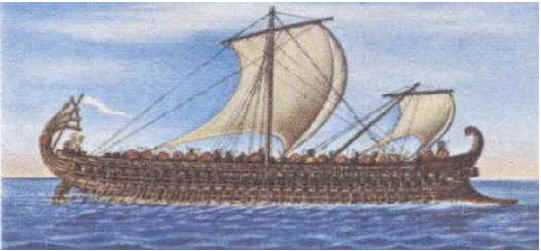
In 700BC the Bireme was developed when someone came up with the idea of using two tiers of oars. The lower tier of oars were fitted directly to the hull and operate exactly as they had in earlier ships. The upper tier of oars were fitted to the sides of the upper deck and the upper oarsmen sat further outward, giving room for both tiers of oars to work. Biremes had a narrower beam than Penteconters of the same length with most having a beam of three meters. Most Biremes carried 100 oarsmen.
In 650BC the first Triremes were built in 650BC, and by 500BC the Trireme was the most widely used heavy warship of the Greek city-states. It was called Trireme because it had three tiers of oarsmen. The Trireme also had a partial or full fighting deck above the rowers. The length of the Trireme remained approximately 35-38 meters, and the beam was approximately 3.5 meters. A Trireme carried 170 oarsmen, plus twenty sailors and fourteen marines in Greek navies. The top speed of a Trireme was approximately 11.5 knots. Some Triremes may have been able to reach higher speeds in short bursts. A Trireme traveling from Athens to Mitylene in 427BC made the 350 kilometer trip in only 24 hours averaging eight knots (14.6 km/h). The Trireme could accelerate much faster than a Bireme or Penteconter, and was much more maneuverable. This gave the Trireme an advantage in combat where higher speed and maneuverability meant a better chance of victory.
The Trireme needed a well-trained and drilled crew of rowers, every man had to respond to commands in unison. A single rower that failed to maintain the stroke could cripple the ship's fighting ability, so only free men could be used on Triremes. This meant they were expensive to maintain, and it took time to train crews to the level needed for combat.