Ancient Greek Boating and Sailing

Boating and sailing became very important to the Greek way of life. The Greeks needed ways to import and export trade goods both within Greece and to other countries. The mountainous terrain of Greece made sailing the easiest way. Wars also caused countries to learn about sailing. Navies became a must in these wars. For instance, the battle of Salamis (480 B.C.) was won because the Athenian navy was superior to the Persian navy.

There were two main types of boats during this time. One was a military ship and the other was a cargo ship. These two ships played a big role in ancient Greece.

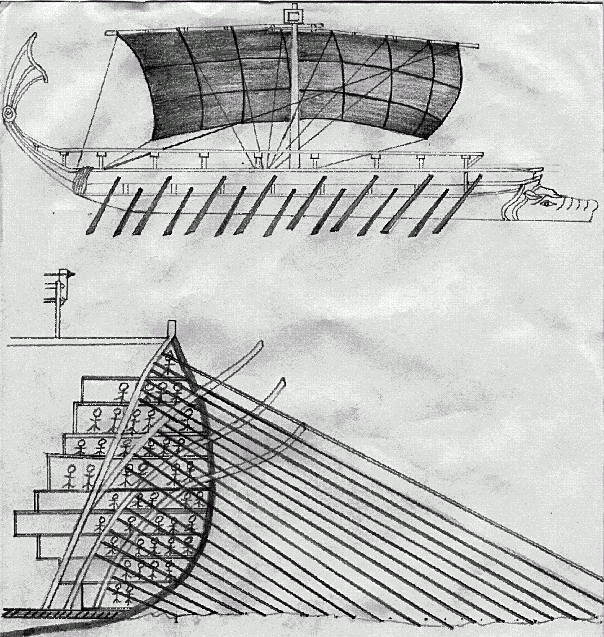
The most prominent fighting ship of this time was the trireme. The trireme was used earlier than the pentekontor. The trireme was a single tier ship and had 25 rowers on each side of the ship. The trireme had two tiers of oars with one man to an oar. They were around 115 feet long and 8.5 feet tall. In good weather conditions these boats could travel around 14 knots an hour. Considering these boats were powered by man, this is quite quick. Since gunpowder wasn't invented yet the Greeks used this military vessel to ram into the enemy's hull. This would disable the ship or sink it. This tactical manoeuvre was called diekplous, or in English "break through and ram." The boats would line up in a square formation. Some would quickly turn and ram into opposing ships. The main weapon for ramming into enemy ships was the beak of the ship. This was covered with heavily weighted bronze beaks.

There was one problem with the trireme. It was rather light and was blown off course when high winds arose. This lead the Greeks to make three and four tier boats called quinqueremes. These had three to four tiers of oars with two men to an oar. This made the boat a lot heavier and less easy to blow off course. These boats were made of wood with metal spikes to hold the wood together. The most common wood used was fir, cedar, and pine. The bottom of these boats were sheathed with lead to protect them from being rammed. Some even melted wax and added a pigment to make it look like paint.
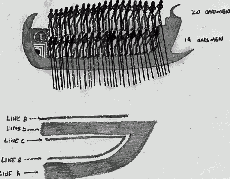
The picture shows that some of the warships used twenty oarsmen on the farside and nineteen on the nearside.

The second most common ship in ancient Greece was the cargo ship. These ships were used to transport imports and exports. These boats are what made ancient Greece prosperous. It saved a lot of time to transport goods by water rather than by land. The land was too mountainous to travel across easily. These ships used sails instead of oars and rowers. Sailing was more technically difficult than rowing since you had to learn about the wind and how to adjust your sail to meet the wind. These ships traveled at an average speed of 5 knots. In order to sail in contrary winds the cargo ships would sail in a zig zag pattern. This caused the ships to travel twice the distance they would have travelled with a good wind, and so it took twice as long as being able to sail direct. Naturally people tried to sail when the wind was in the right direction!

Cargo ships were also made of wood and averaged about 150 tons around 400 BC. Later, in 240 BC, boats were weighing 350 to 500 tons. Ships began adding sails with the increase in size. Two to three masts were common. Some cargo ships were called trading ships or haulers. These ships had very deep hulls and broad beams, wich helped them sail close to the wind. Haulers were usually around 60 feet long.

Understanding navigation was very important to a sailor's survival. Steering, sails, and anchors all were very important to a ship's safe arrival. The trireme was steered by a pair of heavy, broad-bladed oars. These oars were controlled by one man. The sails depended on the strength of the mast. If the mast wasn't strong then adjustments couldn't be made. The sail was raised and lowered according to the wind. When the wind was light the sail was fully extended. When the wind became gusty and strong the sail would be lowered. In severe wind and storm the sails would be lowered completely for fear that the ship might be blown over. Anchors became very important. It meant survival or total loss while at shore. In early Greek times a plain stone was used to hold the boat in place. This faced the Greeks with two problems: how to get the arm of the anchor to bury itself, and how to get it to stay. The Greeks then made an anchor with two arms which were perpendicular with the sea flow. The arms could 'saw' their way into holding position. These were like the anchors we use today. Anchors were made of wood and lead. The lead made the tip and the top of the anchor. The body was made of wood.

Sailing and boating of Ancient Greece began as very basic, but there were a lot of improvements over time, so that they soon became very efficient in their sailing techniques. This is one reason why the Greeks were so powerful in their time.

You Might Also Like:

The New Testament

Included here are articles that deal with aspects of specific New Testament Books or passages, but does not include Lectionary Commentary articles. For more general articles on the New Testament, see Bible Topics, Issues in Biblical Interpretation, Biblical Theology, The Bible in the Church, and Hi...
Read More

The Old Testament

Included here are articles that deal with aspects of specific Old Testament Books or passages, but this does not include Lectionary Commentary articles. For more general articles on the Old Testament, see Bible Topics, Issues in Biblical Interpretation, Biblical Theology, The Bible in the Church, a...
Read More

Gospels

DefinitionLiterary StyleSynoptic GospelsSynoptic ProblemThe ProblemProposed SolutionsTheory of Mutual DependenceTheory of Documentary HypothesisTheory of Oral TraditionEclectic ViewWhy SimilaritiesWhy Diferences?Definition The Term Gospel comes from an old Anglo-Saxon word godespel meaning God's tid...
Read More

Timeline

37 B.C.–4 B.C. - The reign of Herod I, a Roman client king of Israel27 B.C.-14 A.D. - The reign of Caesar Augustus, the first emperor of the Roman Empirec. 6 B.C. - The birth of Jesus26-36 A.D. - Pontius Pilate the Prefect of the Roman Empire's Judaea Provincec. 30-33 - The death and resurrection o...
Read More

Miracles

Description The term miracle is a general term used to describe extraordinary workings of God in the world during certain times of man's history. However there are several terms used in Greek and Hebrew to describe what is commonly called miracle. Miracles of Jesus Miracles of Elisha Marvellous Work...
Read More

Fonts for Biblical Studies

Free Unicode fonts and keyboards Unicode fonts are now becoming standard, and they are easy to use with the free Tyndale Unicode Font Kit. Almost all word processors now support unicode - with the notable exceptions of Word Perfect on the PC and Word on the Mac before Word 2004. If you use Windows 9...
Read More

Korean Fonts

Mac Korean Mac Korean is a bit-mapped suitcase that contains the fonts named Inchon, KSL, Pusan and Seoul. With these fonts you can write in Korean without the Korean Language Kit or HanTalk. [Thanks to S. Todd Stubbs and Sol Yang Hwan of BYU for the instructions included with these fonts.] Downloa...
Read More

Hebrew Fonts

BST Hebrew (16 KB; ttf).David New Hebrew (14 KB; ttf).Dor (46 KB; ttf).ElroNet (Monospace and Proportional) (30 KB; ttf).Gideon-Medium (19 KB; ttf).Hadasah (19 KB; ttf).Hebrew (38 KB; ttf).Hebrew Bold, Italic, Bold Italic (61 KB; ttf).Hebrew Parse (26 KB; ttf).Hebrew Regular (36 KB; ttf, afm).Hebrew...
Read More

The Copper Scroll (3Q15)

Column 1 In the ruins which are in the Valley of Achor, under the steps which go eastward, forty rod-cubits: a strongbox of silver and its vessels - a weight of seventeen talents. KEN in the sepulchre of Ben Rabbah the Third: 100 ingots of gold. In the big cistern in the court of the peristyle, in a...
Read More

Texts

The Book of Secrets 1Q27, 4Q299-301 4Q301 F1 (...) I shall speak out freely, and I shall express my various sayings among you (...) (.. those who would understand parables and riddles, and those who would penetrate the origins of knowledge, along with those who hold fast to the wonderful mysteries ....
Read More

A Baptismal Liturgy (4Q414)

The present work was evidently intended to govern a ritual of baptism or ablutions. A sectarian text by virtue of its mention of the Yachad, this liturgy may have operated during the ritual washings that are discussed in the Charter (see text 5, 3:4-9; 4:21; 5:13b-14). The Liturgy's distinctive form...
Read More

Tongues of Fire (1Q29, 4Q376)

1Q29 F.1 (...) (...) the stone, just as the LORD commanded ....) and your Urim. And it (the cloud?) shall come forth with him, with the tongues of fire. The left-hand stone which is on its left side shall be uncovered before the whole congregation until the priest finishes speaking and after the clo...
Read More

The Coming of Melchizedek (11Q13)

Col.2 (...) And concerning what Scripture says, "In this year of Jubilee you shall return, everyone f you, to your property" (Lev. 25;13) And what is also written; "And this is the manner of the remission; every creditor shall remit the claim that is held against a neighbor, not exacting it of a nei...
Read More

The Thanksgiving Psalms

Psalm 4. I thank you, O Lord,for your eye is awake and watches over my soul.You rescue me from the jealousy of liars,from the congregation of those who seek the smooth way.But you save the soul of the poorwhom they planned to destroyby spilling the blood of your servant. I walked because of you - bu...
Read More

The Parable of the Bountiful Tree (4Q302a)

F.1 Col.2 Please consider this, you who are wise: If a man has a fine tree, which grows high, all the way to heaven (...) (...) of the soil, and it produces succulent fruit every year with the autumn rains and the spring rains, (...) and in thirst, will he not (...) and guard it (...) to multiply th...
Read More

Map of Ancient Jerusalem

After 1380 B.C.Jebus, the original name of ancient Jerusalem, is populated by the Jebusites (a Canaanite tribe). It is a city built on seven hills. A partial siege carried out by the tribe of Judah against the city (Judges 1:8) takes place a short time after the death of Joshua. 1010David begins his...
Read More