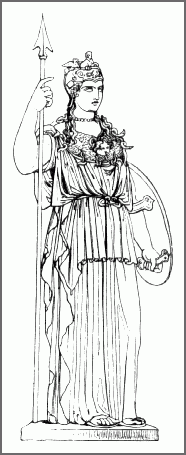
Fierce warriors, they wielded spear and sword in defense of children and motherland. The ancient Greeks considered the Amazons their most fearsome opponents, defenders of an ancient woman-centered faith who had to be defeated that father-rule might prevail - so it is that Penthesilea leads her Amazons in defense of matriarchal Troy. It was the Greeks who named them "Amazon" from amazos, that is, "without a breast." And so the legend has come down to us of ferocious women warriors who cut off their right breast, that it not hinder their use of the bow; who fought and often defeated the greatest of the Greek heroes; and who finally retreated into the mist-enshrouded mountains of Anatolia and Armenia and Bactria as wave after wave of patriarchal warriors invaded their lands.
The historical factuality of Amazons as a people is a debate which has raged in academic circles for centuries. Were the Amazons "real"? In the case of the Greeks, the Amazons they wrote of seem to have been a combination of fact, mythology and male fantasy. (Historically, the particular Amazons the Greeks wrote of seem to have been tribes of women, and maybe even men, who fought the armed invasions by the Indo-Europeans.) On the other hand, some tales of the Amazon are obviously fictional: for a particular society the Amazon becomes the "Other," the being upon whom are projected all of the society's doubts, fears and prejudices; the Amazon is the exact opposite of what a proper woman should be, her culture is the unnatural opposite of the natural order. However, evidence has been found throughout the world of women warriors, not just as anomolous curiousities but as standard features of society. The daughters of noble Japanese families were trained for battle and were skilled in the use of the naginata. Joan of Arc was not the only woman of Medieval Europe to lead soldiers in battle: Queens, noblewomen and nuns had been doing so for centuries. The King of Siam was protected by an elite bodyguard of women warriors. Warrior queens are a common element of African folk-history, among the most famous being Aminatu and Jinga Mbande. Vietnamese women were savage warriors who fought on both sides of their civil war, and many Russian women were decorated for valor during both World Wars. Even where archaeological evidence is lacking, surely the preponderance of stories featuring women warriors points to their historical existence.
The fictional, mythical Amazon has changed her image and function to suit the needs of the people and the times. She has also changed the battles she has fought. The Amazon has been chaste defender of the Christian faith, sword-wielding Abbess, valorous Medieval Christian Crusader and loyal daughter of Islam. She has been samurai and ninja. She has been the denizen of a Lost Valley, Victorian explorer of strange lands, Suffragette and Abolitionist, courageous war nurse and pilot, and futuristic seeker of new life and civilizations. She has wielded as her weapons sword and spear, pistol and whip, picket signs and clubs, speech and pen.
The Amazon of fiction and dream is always noble, courageous, intelligent and - above all - independent, and the women who have willingly or unwillingly earned the name Amazon often emulate these qualities. Each, in her own way, has sought and fought to improve the quality of life for herself, her sisters and her children. Some have purposefully sought battle, while others fell into the midst quite unexpectedly. Some fit the classical ideal of Amazon; that is, they fought on the traditional field of battle with pistols and swords. For others, the field of battle is the picket line, the classroom, the hospital, the factory, the laboratory and houses of politics.
Profiled here are a few such Amazons. They have been divided into eight categories--traditional, social, political, economic, educational, environmental, journalistic and religious - though many cross over into other Amazonian spheres and even into Muse.