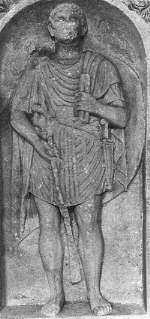
This is the first trial version of A Beginner's Guide to Roman Arms and Armour. Find out (nearly) everything you ever needed to know about what the well-dressed Roman soldier was wearing during the 1st century AD. Don't be too surprised if it is not quite what you were expecting!
The tombstone of Publius Flavoleius Cordus shows us a legionary of the Fourteenth Legion shortly before it joined the force which invaded Britain in AD 43. He wears a tunic, but no armour, and carries his shield slung over his left shoulder. He is holding a spear of some kind (too damaged for certainty) and wears two belts around his waist, with a sword on one and a dagger on the other. He is holding a scroll in his left hand - possibly his will or even an honorable discharge certificate.
Helmet
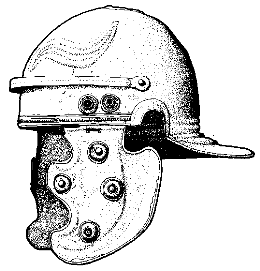
Roman helmets were made of iron or copper alloy (both bronze and brass are known). The main features are the bowl, a neckguard (to protect from blows to the neck), cheekpieces (to protect the sides of the face), and a browguard (defending against downward blows to the face).
Many helmets had fittings to allow for the attachment of crests.
Soldiers often punched or scratched their names and those of their centurions onto their helmets as a mark of ownership.
Body armour
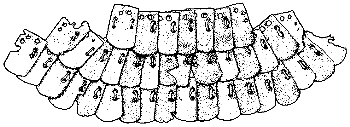
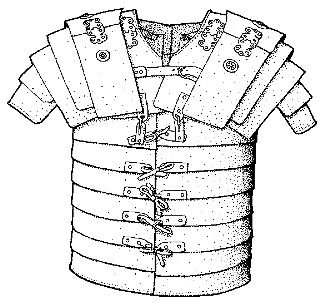
The Romans used three main types of body armour: mail, scale (on the top in the illustration), and segmental (shown at the bottom). All body armour would have been worn over a padded arming doublet.
Mail was normally made of iron rings, each riveted one interlinked with four other punched or welded rings. In the early imperial period, the wearer's shoulders were reinforced with 'doubling' which was fastened across the chest. Used throughout the Roman period.
Scale armour was made of small plates of iron or copper alloy wired to their neighbours horizontally and sewn to a fabric or leather backing. In the 2nd century A.D., a new form of semi-rigid cuirass was introduced where each scale was wired to its vertical, as well as horizontal, neighbours. Similarly used throughout the Roman period.
Segmental armour consisted of overlapping curved bands or iron fastened to internal leather straps. Used from the 1st to 3rd centuries A.D.
Limb armour
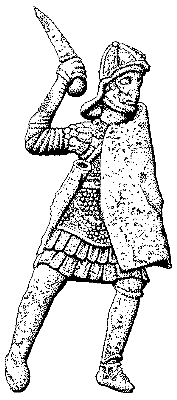
Greaves were worn by centurions and Republican legionaries (although they were also occasionally used by legionaries in the imperial period ).
Segmental arm guards of both iron and copper alloy were also used by infantry, examples being known from Scotland, Austria, and south-east England and they are shown on sculpture being used in Trajan's Dacian wars (see illustration). Like segmental body armour, the individual plates were attached to flexible leather straps.
Cavalry also wore greaves as part of their 'sports' equipment when involved in the elaborate practice manoeuvres known as the Hippike Gymnasia.
Shield
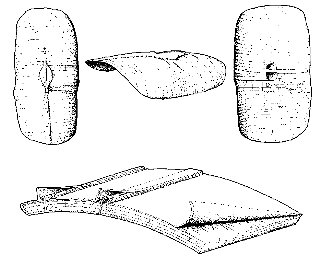
Roman soldiers carried a shield on their left hand side. Legionaries had a curved shield (oval in the Republican period - as in the illustration here - rectangular in the Imperial) whilst auxiliaries had flat ones, with a variety of shapes (oval, hexagonal, rectangular) recorded.
Shields were usually made of double or triple thickness plywood. They were edged with copper alloy binding and had a central iron or copper alloy boss covering the horizontal handgrip. In the later imperial period, oval plank-built shields came into use, sometimes edged with rawhide shrunk into place.
Sword

In the 3rd or 2nd century B.C., the Romans adopted a long-pointed, double-edged Iberian weapon which they called the 'Spanish sword'. This basic design, with various modifications continued through to the 2nd century A.D.
Ordinary infantrymen and cavalrymen wore their swords on the right side, but centurions wore them on the left.
Cavalry used a longer, narrower, sword that followed Celtic types. This was eventually adopted by infantry as well and - now worn on the left - replaced the 'Spanish sword'.
Dagger
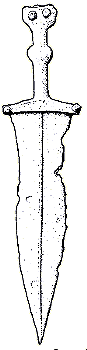
Like the sword, the Roman dagger was also adopted from Iberian examples. In the 1st century A.D. the weapons were often carried in elaborately decorated sheaths inlaid with enamel or precious metals.
Daggers grew larger in the 2nd century A.D., although they retained the same basic form as their predecessors and still resembled their Spanish ancestor.
Spear
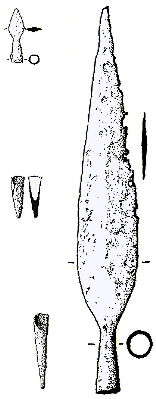
A range of spear types seem to have been used, from light javelins for skirmishers, to thrusting spears for line infantry (including some legionaries), right up to two-handed lances used by armoured cavalry.
Spears had a conical metal shoe or butt which allowed them to be stuck into the ground without damage to the shaft, but it could also serve as a secondary weapon if the head (which was usually of iron) should be broken.
Shafts were made from coppiced poles of woods like ash or hazel which possessed the right qualities of flexibility and strength.
Javelins were occasionally used with a throwing strap to improve their range.
Pilum
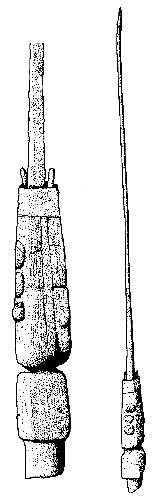
The pilum was a heavy javelin, used by legionaries in battle as a short-range shock weapon. It had a pyramidal iron head on a long iron shank, fastened to a wooden shaft. There is represenational evidence that suggests weights were added to pila in the imperial period, presumably to improve their penetrative capabilities.
Early imperial examples from Oberaden in Germany survived with most of their wooden shafts, as well as their iron fittings, intact.
The head was presumably intended to penetrate both a wooden shield and body armour, the long iron shank passing through the hole made by the head.
Once the weapon had struck home, the shank might bend, rendering it impossible to return it.
Belt
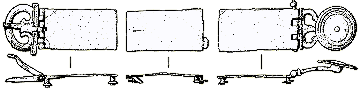
The belt was mainly used as a suspension method for the sword and dagger, although it could help to transfer part of the weight of a mail cuirass from the shoulders to the hips. Baldrics became more common in the 1st century A.D. Sometimes two belts were worn, one for the sword and one for the dagger.
Infantry belts were decorated with attached copper alloy plates, themselves often adorned with embossed or inlaid designs and finished with a tin wash or silver plating.
Tunic
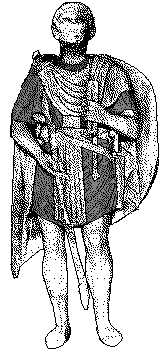
The military tunic was characteristically worn above the knee, a distiction only shared, strangely enough, by slaves. Ordinary citizens did not expose their knees.
The tunic was worn under the armour and seems to have been like a large baggy T-shirt in form, seamed along the sides. We do not know for certain what colours were used, although scholars have suggested both red and white as common military tunic colours (the evidence is equivocal). Materials used included wool and linen.
In the accompanying illustration, the exposed areas of Flavoleius' tunic have been shaded.
Boots
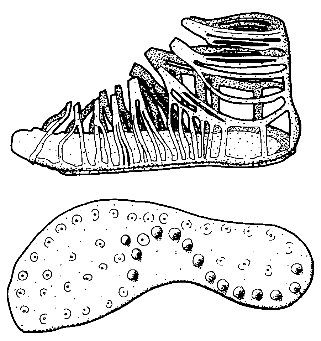
Made of leather, these boots (it is incorrect to call them 'sandals') were elaborately cut out from a one-piece upper with separate soles finished with conical iron hobnails. The boots were laced all the way up the front.
The nailing designs on the sole are arranged very ergonomically and anticipate modern training shoe soles designed to optimize the transferral of weight between the different parts of the foot when placed on the ground.
Sculptural evidence shows that socks would be worn within the boot, open at the toe and the heel.