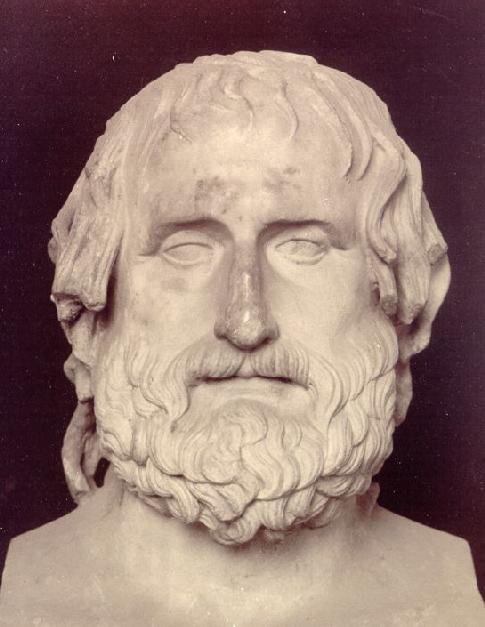
Euripides (meta-index)

Euripides (meta-index) hero image

Euripides was one of the three great tragedians of classical Athens, along with Aeschylus and Sophocles; he is the youngest of the three. He was born c. 480 BC. His mother's name was Cleito, and his father's either Mnesarchus or Mnesarchides. There is a tradition that states Cleito earned an income by selling herbs in the marketplace; Aristophanes found this to be a source of amusement and used it in many comedies. However, there is significant evidence which leads most to believe that Euripides' family was quite comfortable financially, and wouldn't have needed such a source of income.

According to ancient sources, he wrote over 90 plays, 19 of which are extant, although it is widely believed by scholars that the play Rhesus, which is attributed to Euripides, was actually written by someone else. The number of Euripides' plays that have survived is more than double that of Aeschylus and Sophocles, largely due to the chance preservation of a manuscript that was likely part of a complete collection of his works. The record of Euripides' public life, other than his involvement in dramatic competitions, is almost non-existent. It is known that he travelled to Syracuse, Sicily, on a diplomatic mission, but if he engaged in any other public or political actives during his lifetime, such information has not survived. It is known that he was very skeptical of Greek religion, and tradition holds that he associated with various Sophists. He had a wife named Melito, and together they had three sons.

Euripides first competed in the famous Athenian dramatic festival in 455 BC, one year after the death of Aeschylus. He came in third. It was not until 441 that he won first place, and over the course of his life Euripides claimed a mere four victories. When compared with Aeschylus, who won thirteen times, and Sophocles, with eighteen victories, one can see that Euripides was the least popular of the three among his contemporaries. His final competition in Athens was in 408, and soon after he left Athens at the invitation of Archelaus, and stayed with him in Macedonia. Although there is a tradition that he left embittered because of his defeats, there is no real evidence for this position. He died in Macedonia in 406, and after his death his fame overshadowed both Aeschylus and Sophocles. His works were later idolized by the French classicists. Euripides' greatest works are considered to be The Bacchae and Medea.

You Might Also Like:

The New Testament

Included here are articles that deal with aspects of specific New Testament Books or passages, but does not include Lectionary Commentary articles. For more general articles on the New Testament, see Bible Topics, Issues in Biblical Interpretation, Biblical Theology, The Bible in the Church, and Hi...
Read More

The Old Testament

Included here are articles that deal with aspects of specific Old Testament Books or passages, but this does not include Lectionary Commentary articles. For more general articles on the Old Testament, see Bible Topics, Issues in Biblical Interpretation, Biblical Theology, The Bible in the Church, a...
Read More

Gospels

DefinitionLiterary StyleSynoptic GospelsSynoptic ProblemThe ProblemProposed SolutionsTheory of Mutual DependenceTheory of Documentary HypothesisTheory of Oral TraditionEclectic ViewWhy SimilaritiesWhy Diferences?Definition The Term Gospel comes from an old Anglo-Saxon word godespel meaning God's tid...
Read More

Timeline

37 B.C.–4 B.C. - The reign of Herod I, a Roman client king of Israel27 B.C.-14 A.D. - The reign of Caesar Augustus, the first emperor of the Roman Empirec. 6 B.C. - The birth of Jesus26-36 A.D. - Pontius Pilate the Prefect of the Roman Empire's Judaea Provincec. 30-33 - The death and resurrection o...
Read More

Miracles

Description The term miracle is a general term used to describe extraordinary workings of God in the world during certain times of man's history. However there are several terms used in Greek and Hebrew to describe what is commonly called miracle. Miracles of Jesus Miracles of Elisha Marvellous Work...
Read More

Fonts for Biblical Studies

Free Unicode fonts and keyboards Unicode fonts are now becoming standard, and they are easy to use with the free Tyndale Unicode Font Kit. Almost all word processors now support unicode - with the notable exceptions of Word Perfect on the PC and Word on the Mac before Word 2004. If you use Windows 9...
Read More

Korean Fonts

Mac Korean Mac Korean is a bit-mapped suitcase that contains the fonts named Inchon, KSL, Pusan and Seoul. With these fonts you can write in Korean without the Korean Language Kit or HanTalk. [Thanks to S. Todd Stubbs and Sol Yang Hwan of BYU for the instructions included with these fonts.] Downloa...
Read More

Hebrew Fonts

BST Hebrew (16 KB; ttf).David New Hebrew (14 KB; ttf).Dor (46 KB; ttf).ElroNet (Monospace and Proportional) (30 KB; ttf).Gideon-Medium (19 KB; ttf).Hadasah (19 KB; ttf).Hebrew (38 KB; ttf).Hebrew Bold, Italic, Bold Italic (61 KB; ttf).Hebrew Parse (26 KB; ttf).Hebrew Regular (36 KB; ttf, afm).Hebrew...
Read More

The Copper Scroll (3Q15)

Column 1 In the ruins which are in the Valley of Achor, under the steps which go eastward, forty rod-cubits: a strongbox of silver and its vessels - a weight of seventeen talents. KEN in the sepulchre of Ben Rabbah the Third: 100 ingots of gold. In the big cistern in the court of the peristyle, in a...
Read More

Texts

The Book of Secrets 1Q27, 4Q299-301 4Q301 F1 (...) I shall speak out freely, and I shall express my various sayings among you (...) (.. those who would understand parables and riddles, and those who would penetrate the origins of knowledge, along with those who hold fast to the wonderful mysteries ....
Read More

A Baptismal Liturgy (4Q414)

The present work was evidently intended to govern a ritual of baptism or ablutions. A sectarian text by virtue of its mention of the Yachad, this liturgy may have operated during the ritual washings that are discussed in the Charter (see text 5, 3:4-9; 4:21; 5:13b-14). The Liturgy's distinctive form...
Read More

Tongues of Fire (1Q29, 4Q376)

1Q29 F.1 (...) (...) the stone, just as the LORD commanded ....) and your Urim. And it (the cloud?) shall come forth with him, with the tongues of fire. The left-hand stone which is on its left side shall be uncovered before the whole congregation until the priest finishes speaking and after the clo...
Read More

The Coming of Melchizedek (11Q13)

Col.2 (...) And concerning what Scripture says, "In this year of Jubilee you shall return, everyone f you, to your property" (Lev. 25;13) And what is also written; "And this is the manner of the remission; every creditor shall remit the claim that is held against a neighbor, not exacting it of a nei...
Read More

The Thanksgiving Psalms

Psalm 4. I thank you, O Lord,for your eye is awake and watches over my soul.You rescue me from the jealousy of liars,from the congregation of those who seek the smooth way.But you save the soul of the poorwhom they planned to destroyby spilling the blood of your servant. I walked because of you - bu...
Read More

The Parable of the Bountiful Tree (4Q302a)

F.1 Col.2 Please consider this, you who are wise: If a man has a fine tree, which grows high, all the way to heaven (...) (...) of the soil, and it produces succulent fruit every year with the autumn rains and the spring rains, (...) and in thirst, will he not (...) and guard it (...) to multiply th...
Read More

Map of Ancient Jerusalem

After 1380 B.C.Jebus, the original name of ancient Jerusalem, is populated by the Jebusites (a Canaanite tribe). It is a city built on seven hills. A partial siege carried out by the tribe of Judah against the city (Judges 1:8) takes place a short time after the death of Joshua. 1010David begins his...
Read More