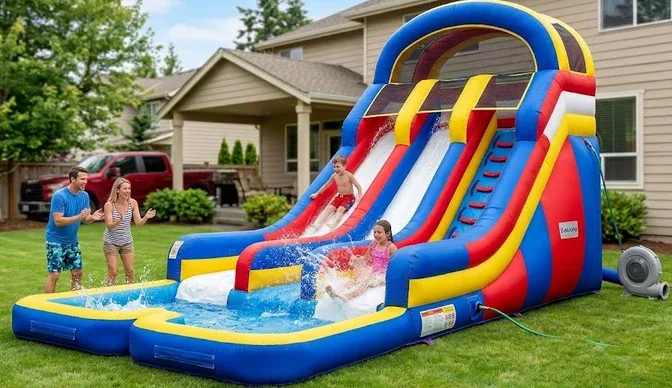
In the competitive US party rental industry, a vibrant, towering water slide is a guaranteed crowd-puller. However, experienced operators know that curb appeal can be deceiving. Many units on the market today look professional on the outside but lack the structural integrity required for heavy commercial use.
For a rental business, a poorly made unit is more than just a bad investment—it is a significant liability. Identifying these "disguised" hazards before you purchase is the only way to protect your reputation and your insurance standing. Here are the five signs that an inflatable slide isn't up to professional standards.
1. The Use of "Retail-Grade" Thin Vinyl
The most obvious sign of an inferior product is the weight and texture of the material. Some manufacturers cut costs by using 12oz or 15oz vinyl, or worse, Oxford cloth with a thin coating.
- The Hazard: Commercial units must use 0.55mm (18oz) PVC vinyl. Thin materials puncture easily and lack the tensile strength to hold high air pressure when multiple children are on the slide. If the material feels "papery" rather than "rubbery," it is a major red flag for a commercial operation.
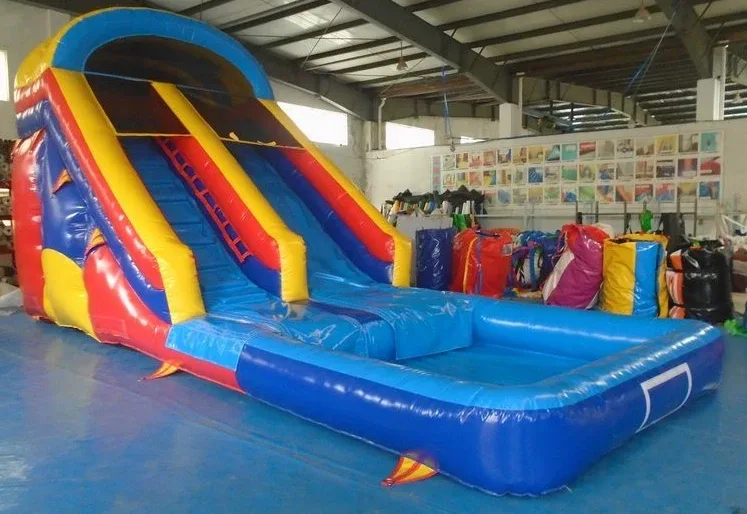
2. Lack of Specialized Anti-Slip Climbing Surfaces
Water and standard vinyl are a dangerous combination. One of the most common causes of rental injuries is children slipping on the climbing wall.
- The Hazard: A poorly designed slide uses the same slick vinyl for the stairs as it does for the slide lane. A high-quality Inflatable Water Slide must have textured, anti-slip vinyl or reinforced foam steps on all climbing areas. If the stairs become a "skating rink" once wet, you are looking at a high-risk unit that could lead to costly injury claims.
3. Missing or Weak Heat-Sealing in Water Zones
If a manufacturer relies solely on standard stitching for the splash pool or slide lanes, water will inevitably leak into the interior of the unit.
- The Hazard: This leads to "internal drowning" of the inflatable. Water trapped inside causes the internal baffles to rot and promotes the growth of toxic black mold. A professional unit should utilize heat-sealed (welded) seams in all areas where water collects. If you see bubbles blowing out of the seams in the pool area, the unit lacks the necessary waterproof integrity.
4. Narrow Slide Walls and Shallow Landing Pools
Safety engineering is about containment. A slide that is designed purely for aesthetics often ignores the physics of a fast descent.
- The Hazard: If the side walls of the slide are too low, a slider can easily tumble over the edge at high speeds. Similarly, the splash pool at the bottom must be deep enough and long enough to provide a full stop. Units that don't adhere to ASTM F2374-19 wall-height ratios are accidents waiting to happen. Professional engineering, such as that found in equipment from EastJump, ensures the slide's trajectory is always safely contained within the unit.
5. Inadequate Anchoring and Structural Reinforcement
A giant water slide acts like a massive sail in the wind. Many budget-friendly units skimp on the number and quality of anchoring points.
- The Hazard: Commercial slides require multiple heavy-duty, stainless steel D-rings reinforced with triple-layer vinyl. If the anchoring points look flimsy or are poorly spaced, the unit is at risk of tipping or blowing away in a sudden gust. Additionally, high-stress areas like the base of the slide must have quadruple stitching; anything less is a sign of a unit that will "zip" open after only a few rentals.
Conclusion: Quality is Your Best Insurance
In the world of inflatables, price is often a direct reflection of safety. A "cheap" water slide often carries hidden costs in the form of higher insurance premiums, frequent repairs, and a shorter lifespan. By learning to spot these five signs of poor construction, you can ensure that your next purchase is a durable asset that grows your business rather than a hazard that threatens it. Investing in professional-grade equipment that meets North American safety codes is the only way to ensure a profitable and sustainable summer season.