Portuguese Coins and the History Behind Them
Portuguese coins are more than pieces of metal used as currency. They are small historical objects that preserve traces of Portugal's political, economic and maritime past.
For collectors, a Portuguese coin can represent a particular monarch, a political transformation, a period of economic change or simply an everyday object that circulated through Portuguese society decades ago. The history of Portuguese coinage is particularly fascinating because it follows the evolution of the country from a medieval kingdom and maritime power to the modern Portuguese Republic.
Among the most recognizable names in modern Portuguese numismatics are the escudo and centavo. But the visual language associated with Portuguese coins goes even further back, to the symbols of Portugal's monarchy, its coat of arms and the maritime imagery connected with the country's Age of Discoveries.
The Portuguese Caravel and the Age of Discoveries
Few symbols are more closely associated with Portuguese history than the caravel.
During the 15th century, Portuguese navigators began systematically exploring the Atlantic and the western coast of Africa. The development and use of agile sailing vessels was essential to these voyages. The Portuguese caravel, particularly the lateen-rigged caravel, was well suited to exploration because its triangular sails allowed the vessel to maneuver effectively in difficult wind conditions.
The caravel became one of the characteristic vessels of the Portuguese Discoveries. It was relatively small compared with later ocean-going ships, but its maneuverability made it extremely useful for coastal exploration and Atlantic navigation.
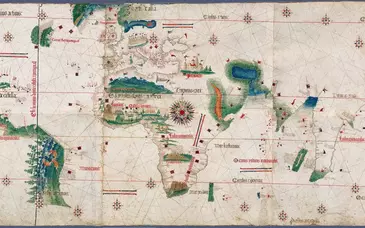
Portuguese maritime expansion gradually pushed the known geographical limits of Europe. Gil Eanes passed Cape Bojador in 1434, Bartolomeu Dias rounded the Cape of Good Hope in 1488, Vasco da Gama reached India by sea in 1498, and Pedro Álvares Cabral reached Brazil in 1500.
The caravel therefore became more than a ship. It became a visual representation of Portuguese exploration, navigation and overseas expansion.
That symbolism remains powerful today, which is why images of caravels frequently appear in Portuguese decorative art, commemorative objects, medals and numismatic designs.
From Maritime Power to National Symbols
Portuguese coinage has long used symbols to communicate identity.
The Portuguese coat of arms, shields, crosses, castles and other heraldic elements appear repeatedly throughout the country's monetary history. The Museu Casa da Moeda describes Portuguese monetary history as a reflection of the country's changing political and cultural identity, with coins representing different stages of Portuguese history over many centuries.
For a coin collector, this makes Portuguese pieces especially interesting. A small coin can contain an extraordinary amount of visual information: the national arms, inscriptions, denomination, date, minting style and political symbolism of the period in which it was produced.
The tradition of collecting Portuguese coins therefore extends well beyond their face value. Their importance lies in the historical context preserved in the design.
The Escudo: Portugal's Currency of the 20th Century
The Portuguese escudo occupies a particularly important place in modern Portuguese monetary history.
The escudo replaced the real in 1911, following the establishment of the Portuguese Republic. The initial conversion was set at 1 escudo for 1,000 réis.
The name escudo itself means shield, an appropriate name for a currency whose designs incorporated the Portuguese national arms and heraldic imagery.
The escudo remained Portugal's currency throughout most of the 20th century. It was divided into 100 centavos, creating a familiar hierarchy of denominations that was used in everyday Portuguese commerce for generations.
For many Portuguese people, escudo coins are therefore not simply collectible objects. They are tangible reminders of everyday life before the introduction of the euro.
The escudo was eventually replaced by the euro. The fixed conversion rate was established at €1 = 200.482 escudos, with euro cash entering circulation in Portugal in 2002.
What Were Centavos?
The centavo was the fractional monetary unit of the escudo.
One escudo was divided into 100 centavos, much as many modern currencies are divided into smaller units. Centavo coins were therefore among the everyday coins encountered by ordinary Portuguese citizens.
Today, these coins can be particularly attractive to collectors because their historical significance is often greater than their original purchasing power would suggest.
A worn centavo may have passed through thousands of hands, shops and households before eventually becoming obsolete. Its surface can preserve the marks of circulation that distinguish an authentic historical coin from a modern reproduction.
For collectors, condition is important, but so are date, denomination, metal, design, minting characteristics and historical context.
Why Portuguese Escudo Coins Are Interesting to Collectors
There are several reasons why Portuguese escudos and centavos continue to attract numismatists.
1. Historical context
The escudo spans a major part of Portugal's modern history. Coins from different periods can reflect changes in government, society, economy and national iconography.
2. Heraldic designs
Portuguese coinage frequently incorporates the national coat of arms and other heraldic elements. Shields, castles, quinas and crosses provide a distinctive visual identity.
3. Variety of denominations
The escudo system produced a broad range of denominations and designs. This gives collectors considerable scope for building chronological or thematic collections.
4. Everyday history
Unlike museum objects that were created specifically to be preserved, circulation coins were designed to be handled and spent. Their wear is therefore part of their history.
5. Connection with Portugal
For collectors interested in Portuguese history, an escudo or centavo offers a direct physical connection with the country's 20th-century past.
Caravels, Coins and Portuguese Heritage
The connection between Portuguese maritime history and numismatics is especially appealing.
The caravel represents exploration and the opening of maritime routes. The Portuguese shield represents national identity. The escudo represents the monetary system of the modern Republic. Together, these symbols form a visual narrative of Portugal: nation, sea, trade and history.
The Portuguese Navy's historical collections emphasize the importance of the caravel in the country's maritime expansion, while the country's numismatic collections demonstrate how coins have been used to express Portuguese identity through the centuries.
This combination of maritime and monetary history makes Portuguese-themed numismatics particularly attractive to collectors around the world.
A Small Collection of Portuguese Coins
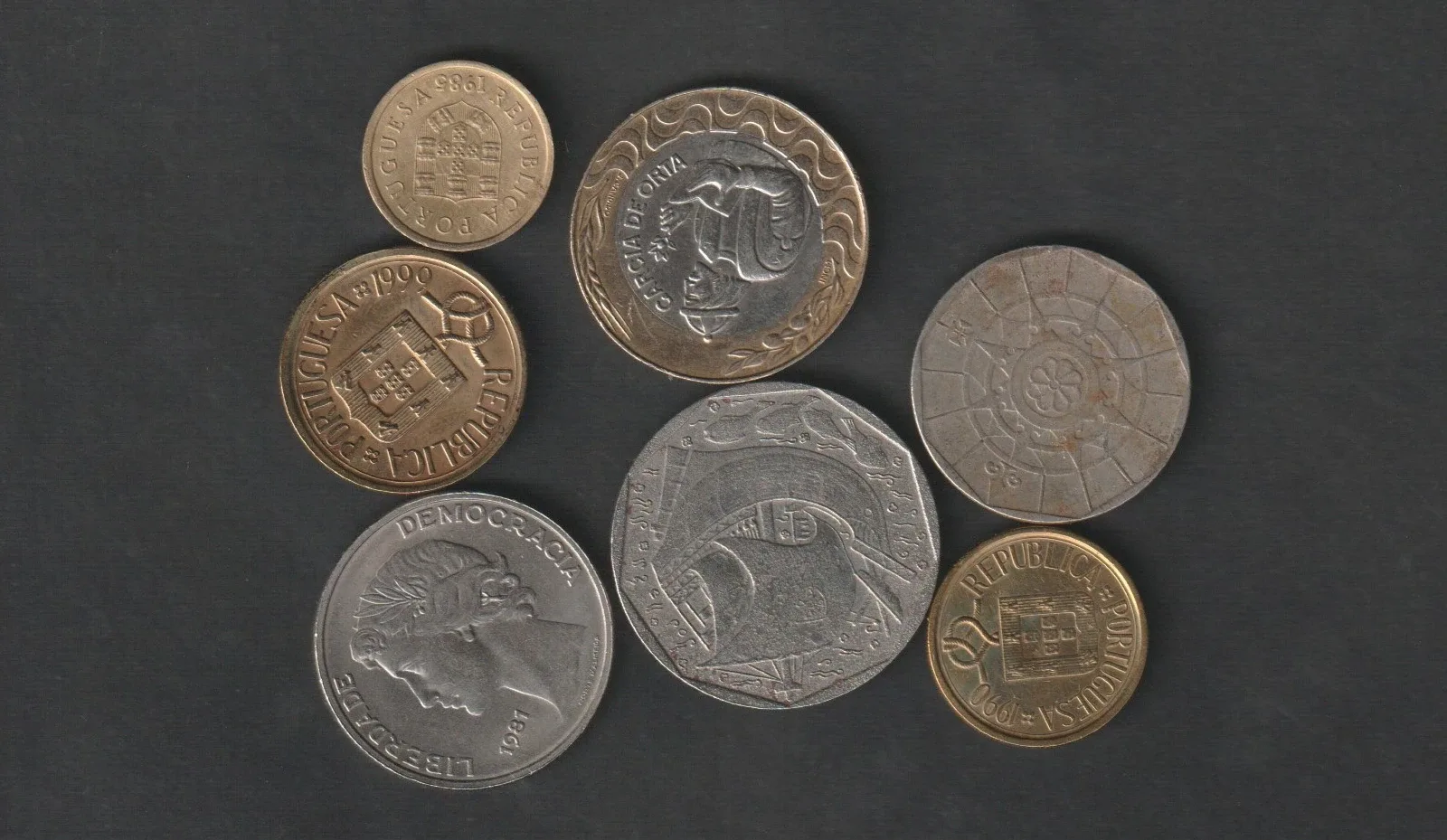
The seven Portuguese coin lots presented in our collection offer an opportunity to explore this history through original numismatic objects.
Each coin should be considered not only for its denomination or monetary value, but also as a historical artifact. Differences in date, design, patina, wear and denomination can tell us something about the period in which the coin circulated.
For collectors, building a group of Portuguese coins can also be approached thematically. Some collectors focus on escudos and centavos, others prefer particular dates or denominations, while some collect Portuguese coins as part of a broader study of European currency.
Whatever the collecting strategy, the appeal remains the same: every coin has a story.
Collecting Portuguese Coins Today
The transition from the escudo to the euro marked the end of an important chapter in Portuguese monetary history. Yet the coins themselves remain widely appreciated by collectors.
A Portuguese escudo or centavo may have little or no monetary value as legal tender today, but its numismatic and historical value can remain significant depending on its rarity, condition, date, minting characteristics and collector demand.
For this reason, old Portuguese coins should not be judged solely by their face value. They are pieces of material history.
Whether displayed individually, arranged chronologically or incorporated into a larger European coin collection, Portuguese coins provide an accessible way to explore the country's past.
From the caravels that sailed beyond the European horizon to the escudos that circulated through Portuguese streets in the 20th century, these small objects preserve a remarkable story of Portugal.
Explore the Portuguese Coin Collection
Our seven Portuguese coin lots on eBay bring together individual pieces of this numismatic history for collectors interested in Portugal, European coins, escudos and centavos.
Each lot offers a different opportunity to own a small piece of Portuguese history — a tangible object connected to the country's monetary and cultural heritage.
For collectors, the attraction is ultimately not just the coin itself, but the story stamped into the metal.
Portuguese coins are history you can hold in your hand.