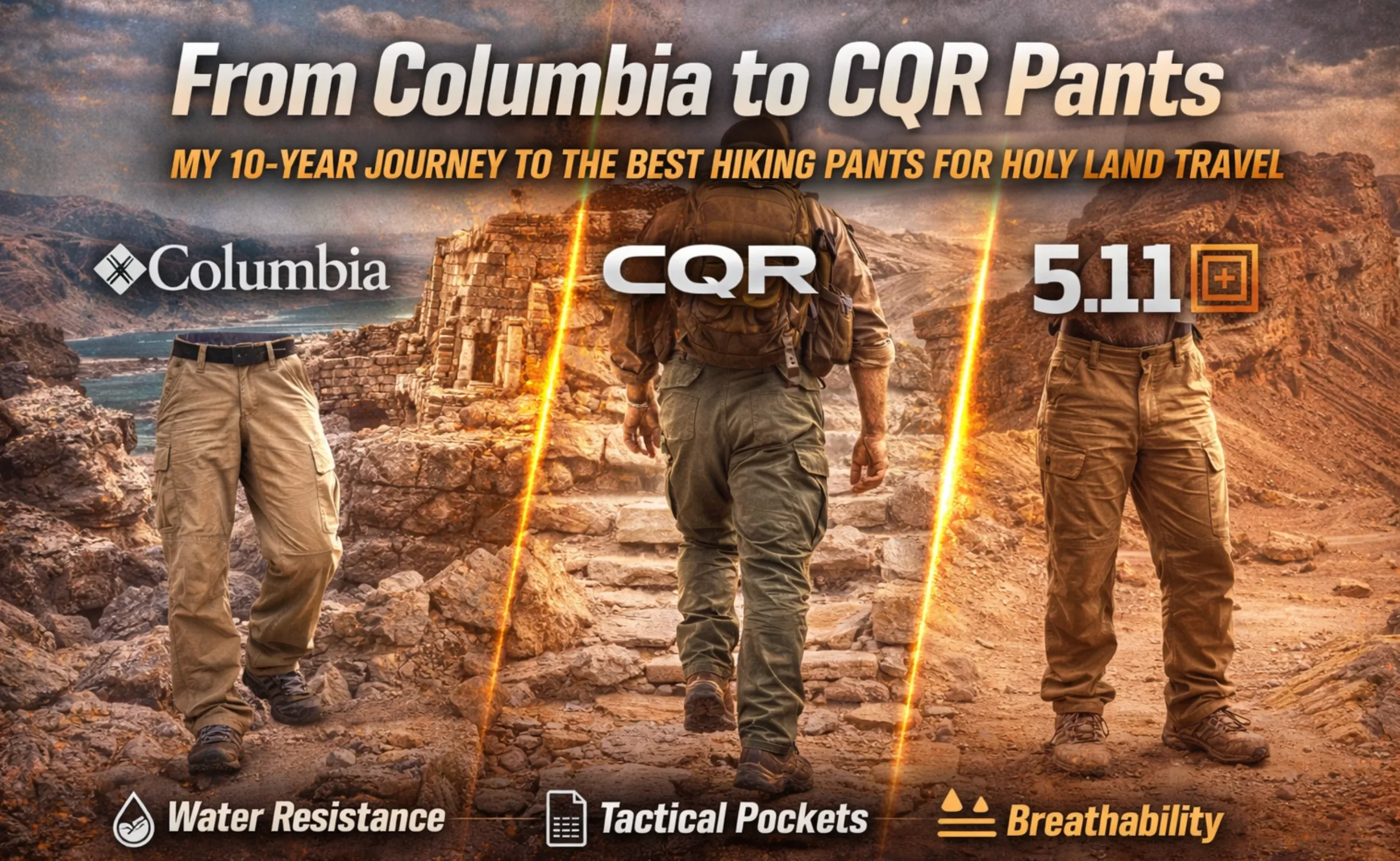
The best hiking pants for Holy Land travel combine water-resistant ripstop fabric, tactical pocket configuration for daily essentials, and breathable construction that handles the extreme temperature swings between the Judean Desert and the Galilean highlands. After leading 23 pilgrim groups through Israel over the past decade and personally testing dozens of hiking pants from brands like Columbia, The North Face, and 5.11 Tactical, I finally discovered that CQR pants deliver the perfect balance of durability, functionality, and comfort for biblical archaeology sites and ancient trail exploration.
This guide shares my decade-long journey of trial and error—from blown-out seams at Masada to sweat-soaked disasters at the Dead Sea—and explains exactly why tactical-style hiking pants outperform traditional outdoor apparel for the unique demands of Holy Land pilgrimage.
Why Standard Hiking Pants Fail in the Holy Land
Most hiking pants designed for American trails can't handle the Holy Land's unique combination of challenges. The terrain ranges from rocky desert wadis to slippery limestone steps at ancient sites. Temperatures can swing 40 degrees between morning prayers at the Western Wall and afternoon explorations in the Negev.
During my first trip to Israel in 2014, I wore my trusted Columbia Silver Ridge pants—the same ones that had served me well on the Appalachian Trail. By day three, climbing the snake path at Masada, I had already torn through the knee fabric on the rough volcanic rock. The lightweight material that kept me cool in Virginia summers offered zero protection against the abrasive surfaces at archaeological sites.
The Holy Land demands hiking pants that can handle crawling through Hezekiah's Tunnel, kneeling on stone floors in ancient churches, sitting on dusty buses for hours, and then immediately transitioning to strenuous hikes through the Judean wilderness. No single category of outdoor pants seemed designed for this combination—until I discovered tactical hiking pants.
The Columbia Years: Learning What Doesn't Work
Columbia Sportswear dominated my hiking wardrobe from 2010 to 2017. Their Silver Ridge and Saturday Trail lines offered decent moisture-wicking and sun protection, but Holy Land travel exposed every weakness in their construction.
The thin nylon fabric tore easily on rough limestone surfaces common at sites like Caesarea Philippi and the ruins of Capernaum. The pocket configuration—designed for casual day hikes—provided nowhere secure to store a passport, phone, and the small Bible I carry for site readings. The relaxed fit that felt comfortable on forest trails became a liability when scrambling over Roman-era ruins or navigating crowded Old City streets.
By 2016, I was destroying at least one pair of Columbia pants per trip. The cost added up quickly. More importantly, dealing with torn pants while leading a group through Bethlehem or Nazareth created unnecessary stress during what should be transformative spiritual experiences.
The 5.11 Tactical Experiment: Too Much of Everything
After hearing recommendations from a military chaplain, I switched to 5.11 Tactical pants in 2017. The durability improvement was obvious right away—the ripstop fabric laughed off the same rocks that had destroyed my Columbia pants.
The 5.11 approach brought its own problems, though. The pants were too heavy for the Judean Desert's summer heat, where temperatures regularly exceed 100°F. The aggressive tactical styling drew unwanted attention at border crossings and security checkpoints. And the premium price point—often exceeding $80 per pair—made me hesitant to subject them to the rigorous treatment Holy Land travel demands.
The 5.11 pants taught me that tactical construction methods work. But the execution needed refinement for travel rather than combat operations. I needed the durability without the weight, the pocket functionality without the military appearance, and the quality without the premium markup.
Discovering CQR Pants: The Tactical-Travel Sweet Spot
My transition to CQR pants happened almost by accident. In early 2019, preparing for a spring trip to trace Paul's journeys through the Galilee, I ordered a pair of CQR Marauder tactical pants from Amazon based purely on their price point and positive reviews.
The Marauder pants addressed every complaint I had accumulated over years of Holy Land travel. The Dura-Flex ripstop fabric—a blend of 63% polyester, 34% cotton, and 3% spandex—provided military-grade durability without the stiffness of pure tactical designs. The stretch component made kneeling for prayers at the Church of the Holy Sepulchre comfortable rather than restrictive.
That first trip with CQR pants changed my approach to Holy Land hiking gear. The pants survived crawling through the low tunnel sections at Megiddo, bushwhacking through overgrown paths near Mount Tabor, and day after day of the rough treatment that had previously destroyed lesser pants within a week.
CQR Hiking Pants Performance Across Holy Land Terrain
The Holy Land presents at least five distinct terrain types that test hiking pants in different ways. After wearing CQR pants through each environment repeatedly over the past five years, I can speak to their performance with confidence.
Desert Environments: Negev and Judean Wilderness
The Negev Desert and Judean wilderness present extreme heat, abrasive sand, and rocky terrain that demands both breathability and durability. CQR's Runyon hiking pants, with their quick-dry fabric and mesh ventilation system, excel in these conditions.
During a 2022 trip that included hiking from Jericho up to Jerusalem via the ancient Roman road through Wadi Qelt, the Runyon pants kept me comfortable through eight hours of sustained desert hiking. The UPF 50+ sun protection proved essential on exposed ridgelines where shade doesn't exist. The convertible zip-off option allowed me to switch to shorts during the hottest afternoon hours.
The water-resistant finish on CQR pants also handles dusty conditions better than I expected. Fine desert sand that would have worked its way into the fabric of my old Columbia pants just brushes off the Duratex ripstop material.
Archaeological Sites: Stone, Dust, and Crawl Spaces
Ancient sites like Bet She'an, Caesarea Maritima, and Qumran feature rough stone surfaces, narrow passages, and archaeological debris that destroy ordinary hiking pants. CQR's reinforced construction addresses each of these challenges.
The double-stitched seams and reinforced knee areas on CQR Raider pants have survived countless hours of kneeling on stone floors at sites across Israel. When exploring the newly excavated areas near the Temple Mount, the tactical pocket configuration kept my flashlight, camera, and notebook secure and accessible—something casual hiking pants can't provide.
At Qumran, where the Dead Sea Scrolls were discovered, the terrain includes sharp limestone fragments, cave entrances requiring hands-and-knees crawling, and steep cliff paths overlooking the Dead Sea. My CQR Vanguard pants handled this environment for three consecutive days without showing real wear.
Urban Holy Sites: Jerusalem, Bethlehem, Nazareth
The holy cities present a different challenge—the need to transition seamlessly from strenuous walking to reverent worship spaces. CQR's Sentinel line, with its urban-tactical styling, bridges this gap perfectly.
The streamlined fit of CQR Sentinel pants looks appropriate for entering the Church of the Nativity in Bethlehem or the Basilica of the Annunciation in Nazareth, while still providing the functionality needed for navigating the steep, uneven streets of the Old City. The quick-dry technology means that sweat from climbing the Via Dolorosa evaporates before entering the Church of the Holy Sepulchre.
I've worn CQR pants to Shabbat services at the Western Wall, Catholic Mass at the Church of All Nations in Gethsemane, and Protestant worship services at the Garden Tomb. The neutral styling never draws unwanted attention, while the practical features continue working in the background.
Galilee Trails: Water, Mud, and Vegetation
The Galilee region around the Sea of Tiberias features lush vegetation, seasonal streams, and trail conditions that change with the weather. CQR pants' water-resistant properties prove their value repeatedly in this environment.
Hiking the Jesus Trail from Nazareth to Capernaum involves stream crossings, muddy paths, and dense vegetation that deposits moisture on pants throughout the day. The Durable Water Repellent finish on CQR hiking pants causes water to bead up and roll off rather than soaking through. That keeps me comfortable through conditions that would leave cotton or standard nylon pants wet for hours.
The reinforced fabric also resists the thorny vegetation common along Galilean trails. Where my Columbia pants would snag and tear on the same brambles that have bordered these paths since biblical times, CQR's ripstop construction deflects the thorns.
Golan Heights: Cold Weather and Rugged Terrain
The Golan Heights, including sites like Caesarea Philippi and the headwaters of the Jordan River, present cooler temperatures and more challenging terrain than the rest of Israel. CQR's Raider pants, with their heavier Duratex ripstop fabric, perform well in these conditions.
During winter trips when snow occasionally covers Mount Hermon and cold winds sweep down from Syria, the substantial fabric weight of CQR Raider pants provides warmth that lightweight hiking pants can't match. The water-resistant finish handles the occasional winter rain that makes Golan trails muddy and slick.
Essential Features for Holy Land Hiking Pants
Based on a decade of testing, I've identified the specific features that matter most for Holy Land pilgrimage travel. CQR pants check every box.
Pocket Configuration
Holy Land travel requires carrying specific items that casual hiking doesn't demand: passport for frequent checkpoints, a small Bible or prayer book for site readings, local currency and credit cards, phone for photography and translation apps, and a flashlight for dark tomb and tunnel explorations.
CQR pants provide 6-8 purpose-designed pockets depending on the model, with secure closures that prevent items from falling out during scrambles over ancient ruins. The tactical pocket layout keeps everything organized and accessible without the bulky appearance of cargo pants.
Fabric Durability
The combination of archaeological sites, desert terrain, and rough stone surfaces demands ripstop construction that prevents small tears from becoming catastrophic failures. CQR's Duratex and Dura-Flex fabrics use the same ripstop technology developed for military applications, ensuring that a small snag on a Roman-era nail doesn't end your trip.
Mobility and Stretch
Pilgrimage involves constant transitions between walking, kneeling, sitting, and climbing. The elastic waistband and spandex content in most CQR hiking pants allows unrestricted movement through the full range of activities that a typical Holy Land day demands.
Temperature Regulation
The Holy Land's temperature extremes—from freezing Golan mornings to scorching Dead Sea afternoons—require versatile pants that work across conditions. CQR's breathable fabrics and ventilation options provide comfort that specialized hot-weather or cold-weather pants can't match across the full range of conditions.
Quick-Dry Properties
Between Hezekiah's Tunnel, Gihon Spring, and the Jordan River baptism site, Holy Land travel involves more water exposure than most pilgrims expect. CQR's quick-dry fabrics eliminate the discomfort of spending hours in wet pants—a common complaint I hear from travelers wearing cotton or slow-drying synthetic blends.
My Current Holy Land Packing List: CQR Rotation
After five years of refinement, I now travel to Israel with three pairs of CQR pants that cover every possible condition.
Summer trips (April-October): CQR Runyon convertible pants for desert hiking, CQR Sentinel pants for urban exploration and worship sites, and CQR Vanguard pants as a versatile backup that handles everything from Masada to the Mount of Olives.
Winter trips (November-March): I substitute CQR Raider pants for their heavier weight and maximum durability, keeping the Sentinel pants for city days and adding CQR Marauder pants for their balance of warmth and stretch on cooler Galilee trails.
This three-pant rotation has survived over fifteen Holy Land trips without a single failure. Each pair of CQR pants typically lasts 3-4 years of this intensive use—a big improvement over the single-trip lifespan of my former Columbia pants.
Cost Comparison: Ten Years of Hiking Pants
The economics strongly favor CQR pants over both budget options like Columbia and premium choices like 5.11 Tactical.
During my Columbia years (2010-2017), I spent approximately $65-75 per pair and destroyed 2-3 pairs annually through Holy Land travel and regular hiking at home. Total cost over seven years exceeded $1,200 on pants alone.
My brief 5.11 Tactical experiment (2017-2019) cost roughly $85-95 per pair. Better durability reduced my replacement rate, but the premium pricing still meant significant annual investment in hiking pants.
Since switching to CQR pants in 2019, I've spent an average of $38-45 per pair, with each pair lasting 3-4 years of heavy use. My total CQR investment over six years has been approximately $400—one-third of what I spent during my Columbia period while getting superior performance.
Frequently Asked Questions
What specific CQR model works best for summer Holy Land trips?
The CQR Runyon convertible pants provide the best combination of hot-weather comfort and travel functionality. The zip-off legs allow switching to shorts during Negev Desert hikes, while the full-length option provides protection and modesty at holy sites. The quick-dry fabric and mesh ventilation handle temperatures exceeding 100°F comfortably.
Are CQR pants appropriate for religious sites with dress codes?
Yes. The CQR Sentinel and Spectre models feature streamlined styling that meets the modest dress requirements at sites like the Western Wall, Church of the Holy Sepulchre, and Al-Aqsa Mosque. Avoid bright colors or heavily tactical models like the Raider when visiting sites with strict dress expectations.
How do CQR pants handle the Dead Sea environment?
The water-resistant finish and quick-dry fabric work well in the Dead Sea's extreme salt environment. I recommend rinsing CQR pants thoroughly in fresh water after Dead Sea exposure to remove salt residue, just as you would with any hiking pants.
Which CQR pants provide the best knee protection for archaeological sites?
The CQR Raider pants offer the most reinforced knee construction, making them ideal for sites like Qumran, Megiddo, and Bet She'an where kneeling on rough stone surfaces is common. The Marauder pants provide a good balance of knee reinforcement and flexibility.
Can CQR pants handle both desert heat and Golan Heights cold on the same trip?
Yes, with the right selection. The CQR Marauder or Vanguard pants work across this temperature range, though travelers may want to layer with base layers for Golan mornings and rely on the breathable construction for desert afternoons.
Final Thoughts on Holy Land Hiking Gear
The journey from Columbia to CQR pants taught me that Holy Land travel demands specialized gear considerations that differ from ordinary outdoor recreation. The combination of archaeological terrain, religious site requirements, extreme weather variations, and security considerations creates a unique set of demands.
After ten years and thousands of miles walked across biblical landscapes—from the heights of Masada to the shores of Galilee, from the narrow streets of Jerusalem to the desert paths of the Negev—I recommend tactical-style hiking pants for serious Holy Land travelers. The durability, functionality, and versatility of CQR pants have made them an essential part of my pilgrimage gear. The value they provide has freed up budget for other aspects of the travel experience.
Whether you're planning your first pilgrimage to walk where Jesus walked or organizing your twentieth group trip to explore biblical archaeology, invest in hiking pants that can match the demands of the terrain. The Holy Land's ancient sites deserve exploration with gear that enables rather than limits your experience.
David Morrison is a biblical tour leader and outdoor educator with over two decades of experience guiding pilgrimage groups through Israel, Jordan, and the broader Middle East. He specializes in connecting biblical history with hands-on site exploration, and has personally walked nearly every significant trail and archaeological site in the Holy Land.