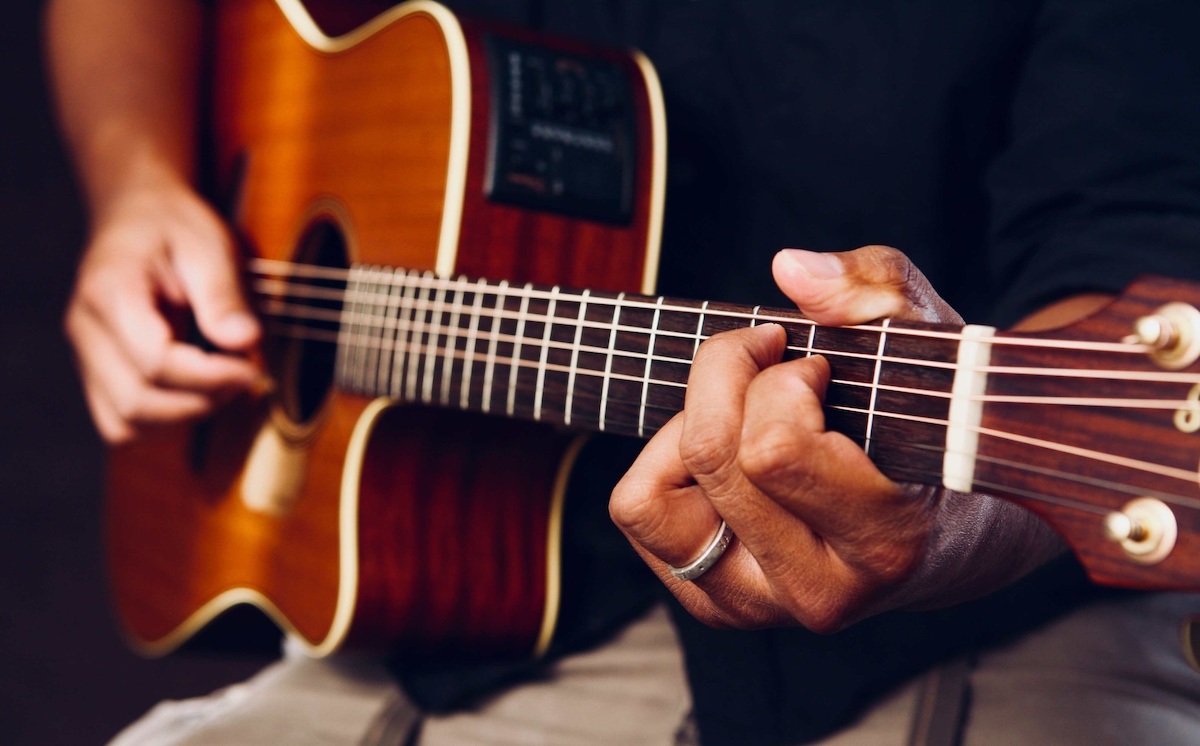
The guitar chord — a fundamental building block of music — is more than just a grouping of notes; it represents a long and difficult evolution of human expression, mathematics, philosophy, craftsmanship, and spiritual resonance. To absolutely understand the guitar chord as it's miles recognised nowadays, we need to explore the ancient roots of musical harmony, the development of stringed gadgets throughout millennia, and the cultural and non secular significance of track, including references determined within the Bible.
I. The Origins of Harmony in Antiquity
Long before the present day guitar existed, people had been experimenting with sound and harmony. Archaeological findings suggest that musical units have existed for tens of heaps of years. The earliest regarded stringed units — consisting of the lyre and harp — date returned to Mesopotamia round 2500 BCE. These contraptions, even though primitive, allowed early musicians to pluck multiple strings simultaneously, creating rudimentary chords.
Pythagoras and the Mathematics of Harmony
The concept of mixing notes to provide appealing sounds become studied in element by Pythagoras of Samos within the sixth century BCE. Using a unmarried-stringed tool referred to as the monochord, Pythagoras observed that precise mathematical ratios among string lengths produced harmonious intervals — the foundation of what we now name musical intervals and scales.
This discovery hooked up the premise for Western musical concord, which later evolved into the triads and chords we companion with guitar track nowadays. The intervals of the octave (2:1), the 5th (three:2), and the fourth (four:3) have been seen now not just as musical gear but as evidence of divine order within the universe.
II. Stringed Instruments in Ancient Cultures
The Lute and Its Descendants
The direct ancestor of the guitar is the lute, which unfold at some stage in the Middle East, North Africa, and Europe. The historic Egyptians used units reminiscent of the lute as early as 1500 BCE. The Arabic oud, delivered into Spain by using the Moors within the 8th century CE, changed into a crucial hyperlink within the development of the European lute and sooner or later the guitar.
The oud had no frets, but musicians mixed notes to shape harmonies, precursors to chords. While single-word melodic traces had been the norm in early music, the idea of strumming more than one strings commenced to take maintain in various folk traditions.
III. Biblical References to Stringed Instruments and Harmony
Though the guitar itself is not mentioned in the Bible, stringed devices play a prominent function, each symbolically and almost, in historical Israelite tradition.
David and the Harp
Perhaps the most famous biblical musician is King David, described as playing the kinnor, a type of lyre or harp. In 1 Samuel 16:23, David’s music is credited with soothing King Saul:
"And it came to pass, when the evil spirit from God was upon Saul, that David took an harp, and played with his hand: so Saul was refreshed, and was well."
The act of gambling a couple of strings together — as one does with the lyre or harp — mirrors the present day idea of playing chords. These units regularly had 7–10 strings and have been tuned in ways that allowed for harmonic gambling. Chords as such had been now not a formalized concept in biblical instances, but the exercise of harmonic accompaniment existed.
Psalmic Worship and Harmony
The Book of Psalms, many of which are attributed to David, contains numerous exhortations to praise God with stringed instruments. For example:
“Praise him with the sounding of the trumpet, praise him with the harp and lyre…”
— Psalm 150:3–4
Music became indispensable to religious lifestyles. The use of harmonic gadgets just like the harp or lyre in worship may be visible as early expressions of the emotional depth we now partner with chordal progressions on a guitar.
IV. The Medieval and Renaissance Periods: Toward Chords and Frets
During the medieval duration in Europe, the improvement of polyphony (song with more than one melodic voice) paved the manner for chords. Though guitars have been still primitive, lutes and vihuelas started out to be tuned and played in methods that resembled contemporary chordal gambling.
By the fifteenth and sixteenth centuries, the vihuela (a Spanish stringed device) and the Baroque guitar became prominent. Musicians used tablature notation, much like what modern-day guitarists use, and strummed chords to accompany songs.
The concept of the chord became formalized during the Renaissance, especially with the codification of triads (root, third, and 5th). These harmonic groupings are the essence of today's fundamental and minor guitar chords.
V. The Classical Era and the Six-String Guitar
The modern six-string guitar become standardized in the late 18th century. Spanish luthiers inclusive of Antonio de Torres helped refine the tool's size, bracing, and soundboard layout, giving upward thrust to the classical guitar.
Composers like Fernando Sor and Mauro Giuliani wrote track with state-of-the-art harmonic structures, employing wealthy chord voicings which can be acquainted to guitarists today.
Chords were not simply accompaniment tools however vehicles for emotional expression, structure, and tension-decision in composition.
VI. Modern Guitar Chords and the Explosion of Popular Music
In the 20 th century, the guitar exploded into prominence in genres like blues, jazz, rock, and folks. Players like Robert Johnson, Andrés Segovia, Jimi Hendrix, and John Lennon extended each the technical and emotional limitations of guitar chords.
Chord Vocabulary and Theory
Modern guitarists now use a great vocabulary of chords: main, minor, faded, augmented, suspended, prolonged (7th, 9th, eleventh, thirteenth), and adjusted chords. Jazz specially treats the guitar as both a harmonic and rhythmic powerhouse.
The simplicity of a G primary or the dissonance of an E7♯nine (“Hendrix chord”) contains the lineage of lots of years of harmonic development — from ancient temples to smoky blues bars.
VII. Spiritual Echoes: Music as Divine Expression
The evolution of guitar chords isn't only a technical or inventive journey; it's miles deeply religious. From the historical Hebrew psalmists to Gregorian clergymen, from the mathematics of Pythagoras to Bach’s counterpoint, harmony has regularly been regarded as a mirrored image of divine order.
Even today, the act of strumming a chord evokes some thing essential. In Christian liturgy, tune is regularly called a present from God, a manner to "make a completely satisfied noise unto the Lord" (Psalm a hundred:1). The guitar chord — whether or not in a worship tune or a love ballad — can be seen as a bridge between the temporal and the everlasting.
A Chord That Connects Eras
The guitar chord is extra than a technical construction; it's miles a made of centuries of innovation, cultural trade, and religious longing. Its roots are in historic mathematical discoveries and sacred rituals, and its branches stretch into every genre and nook of cutting-edge music.
Whether plucked by way of a shepherd-king in biblical instances or strummed by a current singer-songwriter, the chord remains a profound symbol of human creativity — a convergence of sound, soul, and structure.